On Tuesday, March 10th, an EF-1 tornado destroyed the Dunns Bridge Solar I and II facilities owned by the Northern Indiana Public Service Company (NIPSCO). The facilities, located outside of Wheatfield, Indiana, had 2.4 million solar panels, totaling 700 megawatts (MW) of power capacity, and reportedly cost $1 billion to construct—a little over $1,400 per kilowatt (kW).
NIPSCO issued the following statement in the aftermath:
On the evening of March 10, while actively monitoring severe weather and responding to storm‑related outages across our service area, NIPSCO became aware of damage to its Dunns Bridge I and Dunns Bridge II solar facilities in Starke and Jasper counties. Our team was tracking the storm in real time and moved in to assess conditions and respond as soon as it was safe to do so. Debris from the damage could have been displaced, and we are working to safely secure the area, assess the damage and proactively communicate with the community.
We recognize there may be questions and concerns about potential environmental impacts related to the damage at the solar farm. Solar panel leaching concerns have been thoroughly evaluated in industry-leading research, which shows that the risk is extremely low. Overall, the available evidence demonstrates that both crystalline silicon and thin-film PV (i.e., photovoltaic) modules do not pose a meaningful risk of environmental or human exposure from leaching, even when damaged.
The Chief Deputy of Jasper County Sheriff’s Department, Brandon Napier, noted, “Just the path of the tornado that came through, we have several large solar fields to the east of the town here it went right through the solar field and just ripped a lot of them out.”
While the solar panels were damaged by the tornado, we are not aware of any reports of damage at the nearby R.M. Schahfer Generating Station, a 950 MW coal facility that NIPSCO was planning to retire at the end of 2025. However, it is still operational due to a 202(C) order issued by the U.S. Department of Energy requiring the plant to continue operations. Click on the map below to explore the custom Google Map AOER made of the facilities.
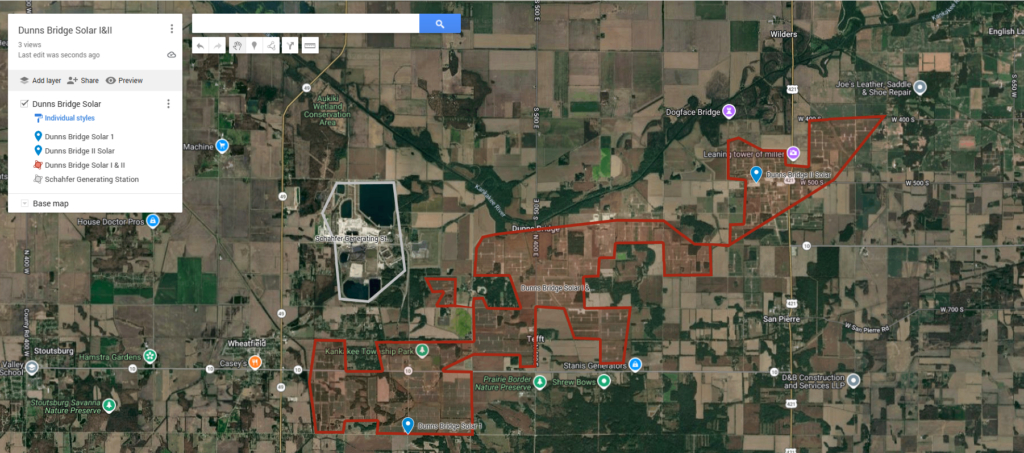
This article will compare the cost of the destroyed solar facility to that of the nearby R.M. Schahfer Plant and examine how energy costs have changed in the NIPSCO service territory in response to changes in the company’s expenditures on its generation, transmission, and distribution assets, using data obtained from S&P Global Capital IQ.
About Dunns Bridge Solar I & II
According to S&P Global, the Dunns Bridge solar projects were built to “support Northern Indiana Public Service’s goal of becoming coal-free by 2028, reducing carbon emissions by more than 90 percent by 2030, compared to a 2005 baseline, according to the utility.”
The situation begs several questions:
- If climate change increases the frequency of severe weather events, does it make sense to shut down existing coal plants to build energy generation facilities, like solar, that are more likely to be destroyed by extreme weather events?
- Are the company’s coal-free and emissions reduction goals increasing the company’s exposure to costs associated with weather events, and why should ratepayers be saddled with these additional costs?
- Was there any damage to the R.M. Schahfer coal plant or the onsite battery storage facility at Dunns Bridge?
- What type of insurance policy is in place for the solar facility, and what deductible would the company be required to pay, if any?
- What liability, if any, does the company have for the cleanup of the site and surrounding areas?
- How is any of this in the best interests of ratepayers?
AOER reached out to NIPSCO via its “24-hour” media hotline to request this information, but NIPSCO did not respond at the time of publication, and we sincerely doubt they will. However, these are questions the company should be required to answer before the Indiana Utility Regulatory Commission at its scheduled March 24th hearing on energy affordability. They can dodge our questions, but they had better come clean to the regulators.
Evaluating the Levelized Cost of Energy Over a Truncated Useful Lifetime
The Levelized Cost of Energy (LCOE) is an estimate of the average cost of producing a megawatt-hour (MWh) of electricity from a given power plant, calculated by dividing its total costs by the number of MWhs generated over its useful lifetime.
In this regard, the LCOE can be thought of as the cost of driving your car on a per-mile basis. If the car is totaled in a car accident after two years, when you anticipated driving it for ten years, the cost per mile obviously increases.
Dunns Bridge I began generating power in June of 2023, producing a total of 1.3 million MWhs up until December of 2025, the most recent month for which data are available. Dunns Bridge II began generating power in January of 2025, and through December, it produced 812,439 MW of power, which equates to a 21.3 percent capacity factor.
We calculated the LCOE over two time periods: a 25-year lifecycle, a standard assumption in the industry, and a 2-year lifecycle to account for the facility being destroyed very early in its lifecycle. The results are about what we would expect. Our estimated subsidized costs over 25 years are approximately equal to the S&P Global reported PPA cost for the facilities, including subsidies.
A shorter lifespan results in a significant increase in the LCOE of the facilities, as the subsidized cost rises from $63.87 per MWh over 25 years to $289.61 per MWh over two years. Similarly, the unsubsidized cost rises from $82.61 per MWh over 25 years to $405.09 per MWh over two years.
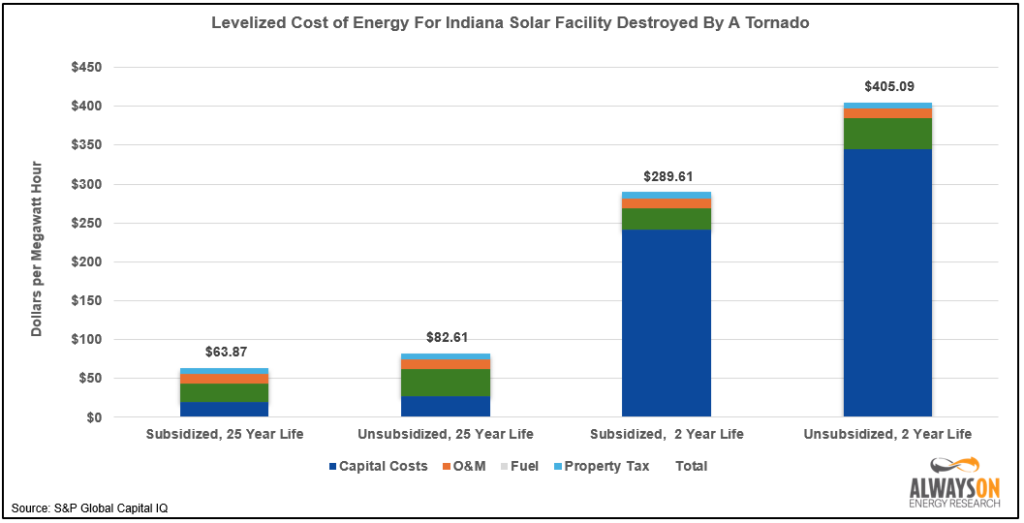
Costs increase so dramatically in these two scenarios because solar facilities are capital-intensive energy facilities, meaning most of the money spent to obtain electricity from them comes in the form of capital expenses, such as the initial cost of building the facility.
Fortunately, the facilities were almost certainly insured and will likely be rebuilt after the site is remediated. The question is: how much are the cleanup and replacement costs, and what is the insurance deductible for the damaged facility, and who will have to pay them?
It’s one thing to have an old roof on your house destroyed by a hailstorm, because you get a new roof for a fraction of the true replacement cost. But it’s another thing entirely to have a brand-new roof destroyed, because then you have the privilege of paying the deductible just to get your new roof back.
This is a situation that NIPSCO’s ratepayers may find themselves in as a result of this event.
The Cost of the Nearby Coal Plant
In our upcoming LCOE study for Reliable Energy Inc. in Indiana, we found that the R.M. Schahfer plant was the most expensive coal plant in the state, primarily due to very high delivered fuel costs ($50 per MWh).
However, the December 2025 data from S&P Global, the most recent available, show the delivered fuel cost was about $27 per MWh, which substantially improves the economics of the plant, although this could possibly be the result of the company assuming the plant would retire at the end of the year, rather than being required to stay open.
At $70 per MWh, the Schahfer plant is competitive with subsidized solar over a 25-year lifespan, cheaper than the unsubsidized cost over 25 years, and a bargain compared with our admittedly uncharitable comparison to the facility’s actual 2-year lifespan.
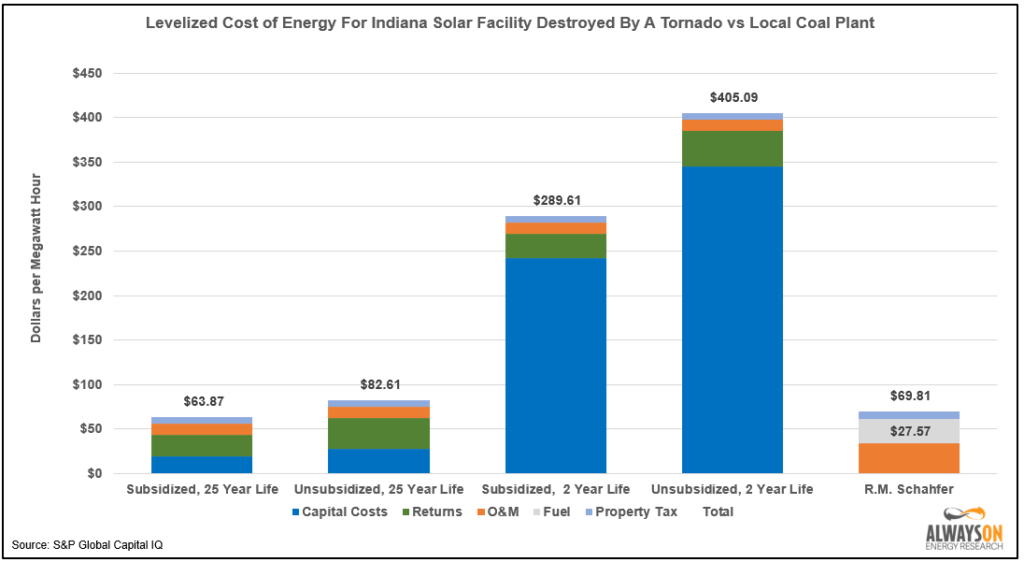
Of course, this analysis does not account for backup power or other hidden costs associated with accommodating the solar facilities. If it did, the Schahfer plant would offer superior lifetime value for NIPSCO ratepayers, even when compared to the subsidized cost of solar panels.
NIPSCO’s Changing Generation Profile
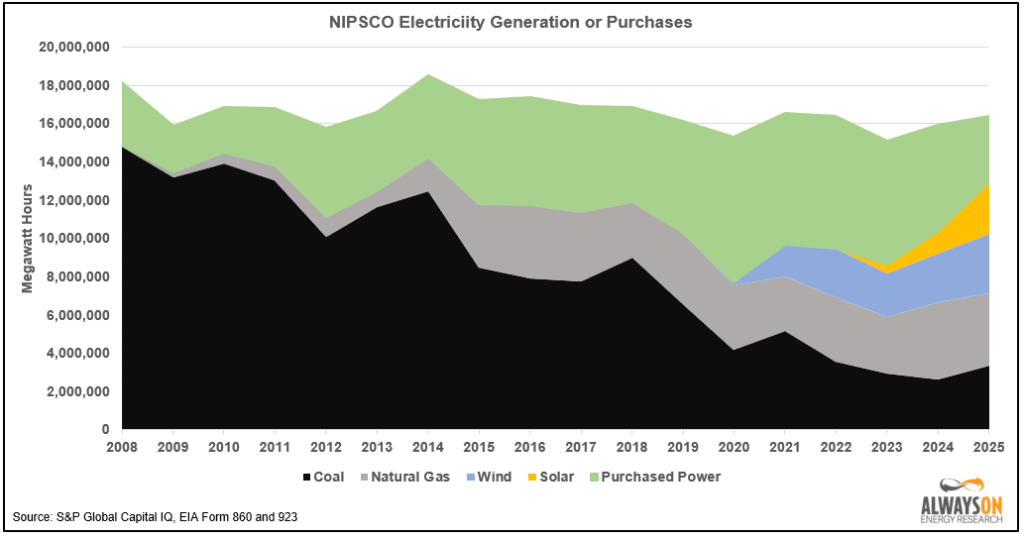
NIPSCO’s Dunns Bridge solar facilities are part of a larger trend away from coal-fired power generation toward natural gas, MISO market purchases, and increasingly, wind and solar ownership or power purchase agreements (PPAs).
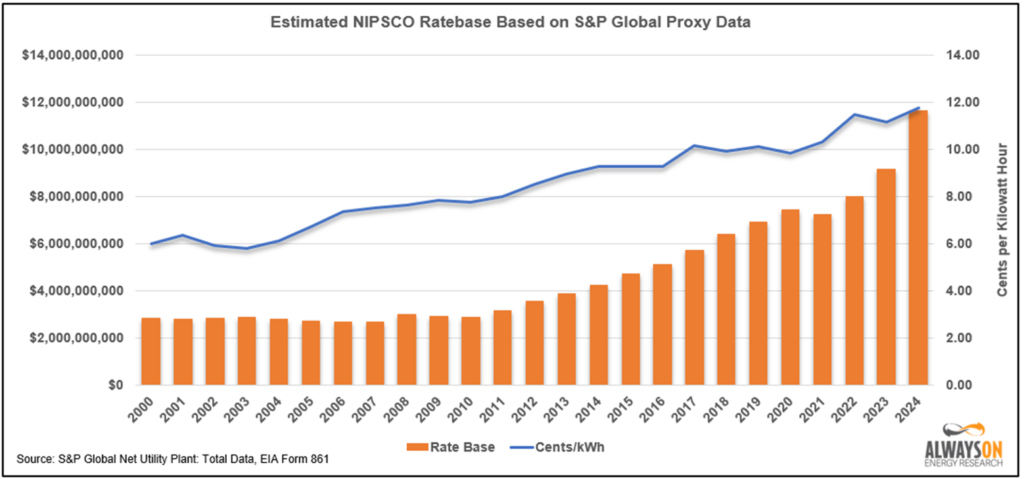
This trend has coincided with a substantial increase in the utilities’ estimated rate base. Data from S&P Global show NIPSCO’s rate base has more than doubled since 2016. Notably, the company’s rate base was essentially flat from 2000 to 2010 in non-inflation-adjusted terms. This is because assets within the rate base depreciate over time, helping offset increases from new investments. The upward trend in rate base growth has coincided with higher rates.
It is also interesting to look at what’s causing the rate base growth. In the mid-2000s and 2010s, NIPSCO’s spending growth was driven by generation spending. However, transmission and distribution spending began to increase around 2018, and generation spending fell in 2021, but rebounded slightly in 2024.
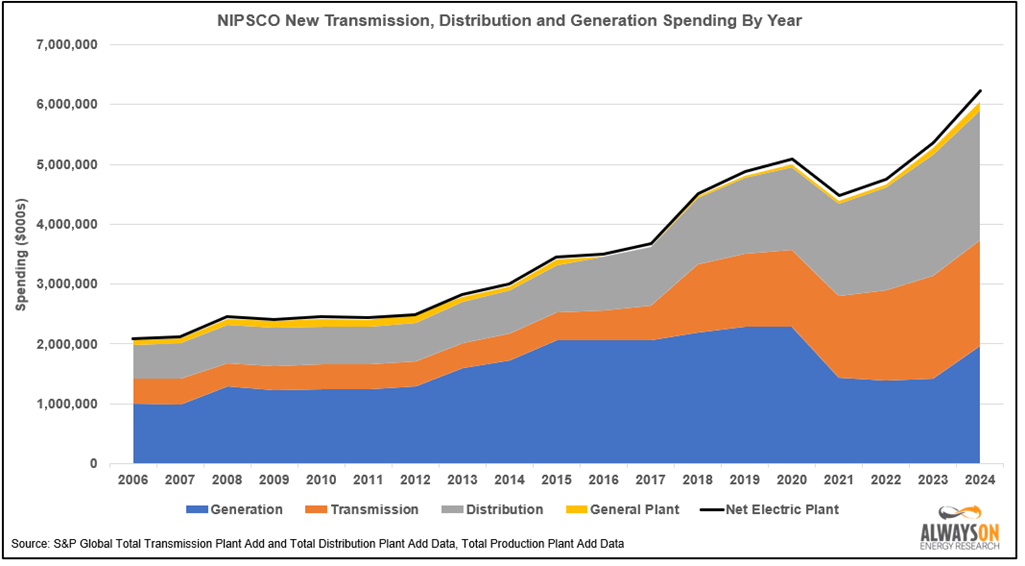
This graph supports some of the arguments made in the Lawrence Berkeley National Laboratory (LBNL) study, which suggested that transmission and distribution, not generation, charges have increased electricity prices since 2020. It is also worth noting that the graph above suggests the LBNL study may be missing significant increases in generation costs that occurred prior to 2020.
A Note On Cleanup and Contamination Concerns, Our Two Cents
Photos of the broken panels have stoked fears on social media about potential environmental damage from toxic chemicals leaching out of the shattered panels into the soil and local groundwater supplies.
We are not toxicologists, but we understand that posts like these can cause local residents to be concerned about the impact of broken solar panels on their families’ health and welfare, so we felt it best to weigh in on the issue to the best of our ability.
For our part, we would encourage those in the surrounding areas not to worry too much about chemicals leaching from the panels into the soil or water. Photovoltaic panels are made mostly of glass, and the small amounts of toxic materials, such as lead used in soldering, are not a significant concern because they are present in small quantities and there is probably no realistic exposure pathway for humans.
In this regard, it’s important to remember that it’s the dose that makes the poison. Taking too much Tylenol will kill you; a small amount will not.
While we are not overly worried about chemicals leaching from the panels, we are concerned about the glass. Glass is not generally considered toxic, but broken glass scattered across neighboring properties is still problematic.
NIPSCO, rather than the impacted neighbors near the facility, should be held financially responsible for the costs of cleaning up the debris caused by the tornado.
Conclusion
There are lots of things that break when they get hit by a tornado, but our power plants shouldn’t be one of them.
The demise of the Dunns Bridge I & II solar facilities by one of the weakest classifications of tornado should be a nudge to Indiana policymakers and utility regulators that shutting down dispatchable thermal plants in favor of flimsier wind and solar facilities is not a prudent course of action.