Isaac Orr, Mitch Rolling, and Sarah Montalbano
On March 2, 2026, Xcel Energy filed a report with the Colorado Public Utilities Commission (PUC) stating the company will likely be in a capacity deficit, meaning it does not meet its reliability requirements, from now until at least 2028, unless it keeps its Colorado coal plants open.
The projected capacity deficit follows nearly a decade of advocacy by Xcel to retire its coal plants before their original retirement dates and a shift to a portfolio consisting of wind, solar, battery storage, and natural gas. For example:
- In 2018, Xcel became the first investor-owned utility in the nation to declare its self-imposed environmental, social, governance (ESG) goal of making its system carbon-free by 2050;
- Xcel has a history of giving thousands of dollars to climate groups like Fresh Energy in Minnesota and Western Resource Advocates in Colorado, and working with them to push for the closure of its coal plants and decarbonization mandates, and;
- Xcel lobbied in favor of the carbon-free electricity mandates passed in Minnesota and Colorado.
Xcel’s March 2026 investor presentation suggests the company understands that such advocacy efforts generate substantial returns for its shareholders. The company boasts that it has met or exceeded earnings guidance for 21 consecutive years, and the utility will grow its rate base by $60 billion between 2026 and 2030 throughout its four primary service territories, with much of the growth stemming from its decarbonization initiatives, thus “Green Plating” its system to increase corporate profits.
In summary, the current reliability deficit Xcel Energy is overseeing in Colorado is the logical end conclusion of the policies the company has been advocating for over the last decade. To state it uncharitably, Xcel is simply reaping the entirely foreseeable consequences of its own self-serving actions.
This analysis examines the company’s resource adequacy position in Colorado and how Xcel Energy’s planned capital expenditures in Colorado are unlikely to address the reliability concerns the company currently faces.
The Comanche Report
On March 2, Xcel Energy filed “The Comanche Report” with the Colorado PUC. The company highlighted the severe resource adequacy deficit it currently faces and the need to delay planned retirements of its coal units. Specifically, Xcel noted the following:
“[T]he Company’s near-term (i.e., 2026 and 2027) resource adequacy position is negative, 2028 is challenged, and these years present significant operational challenges even with Comanche 2 extended through the end of 2026. This report will discuss the limited incremental options for adding capacity resources that are needed. When the June Application is filed, swift action will be needed to shore up power needs for our customers in the near and intermediate terms. Difficult decisions about extending baseload units may be needed and additive transmission needs are likely part of solutioning these issues, as reliability of the system—in addition to the safety and affordability of such—remain the paramount goals of the Company and should be for Colorado as well.”
Further into the report, it states that, “Near-term, the most likely capacity solutions are continued extensions of existing units—namely, Comanche Unit 2 and, to a lesser extent, the Hayden units.”
Xcel also reported that repairing and restarting Comanche Unit 3, which suffered turbine damage in August 2025 and is expected to be back online in 2026, is the most affordable option for ratepayers. The company stated “the incremental cost to replacing Comanche Unit 3 would be magnitudes more expensive for customers than” restarting the facility, and that “there are no reasonable alternatives to returning Comanche Unit 3 to service.”
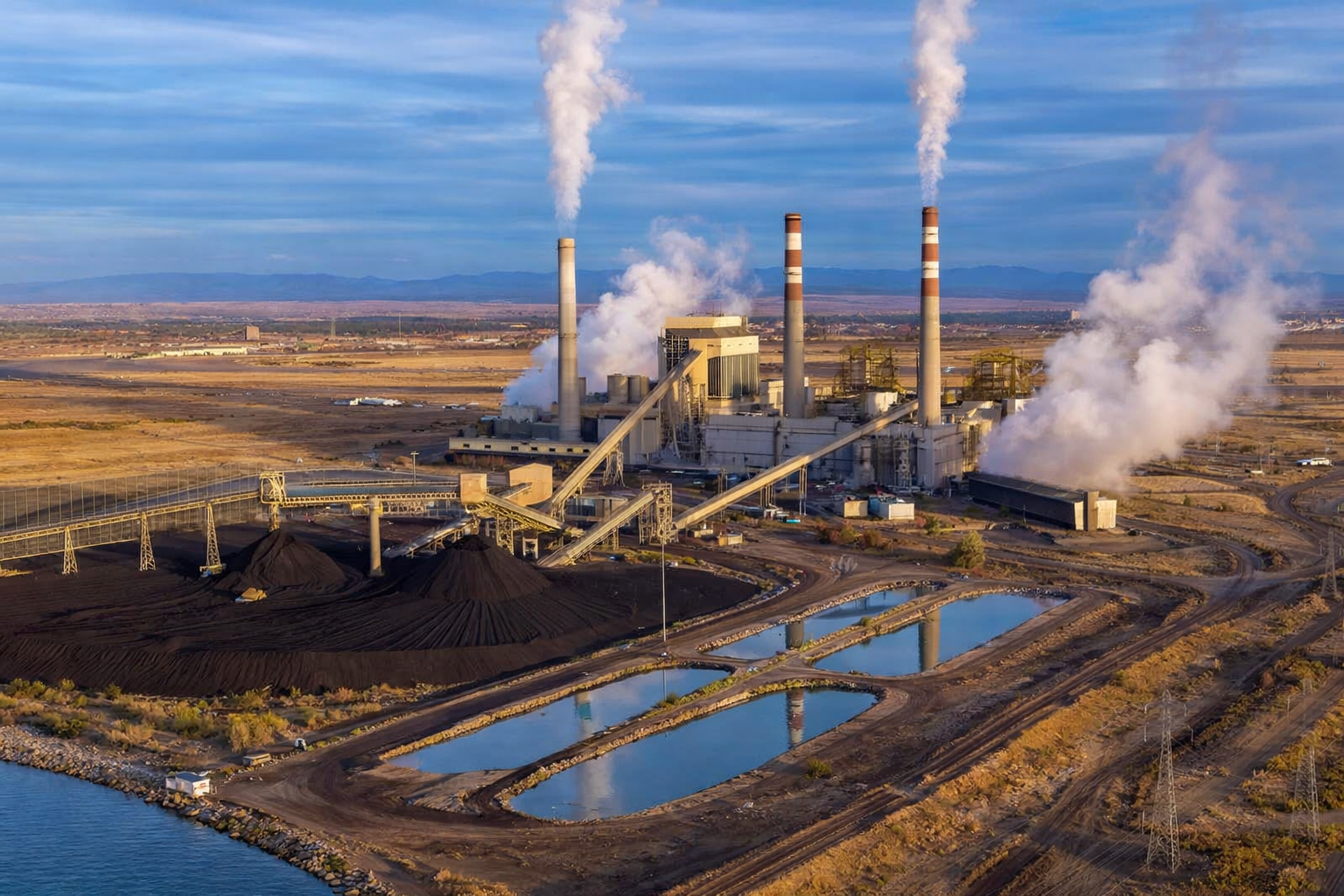
While this is true, it’s also true that accelerating the retirement date of Comanche Unit 3 from 2040 to 2030 is more expensive for Colorado ratepayers than continuing to operate the facility, as AOER authors highlighted in a 2023 report prepared on behalf of the Independence Institute in Colorado:
The accelerated retirement of Comanche 3–from 2040 to 2030–increased the cost of the Polis Plan by $8 billion alone, as the retired coal capacity needs to be replaced with wind, solar, and battery storage 10 years earlier than originally planned. The cost increase occurs because it accelerates the timeline in which investments must be made to replace the plant, which earn a rate of return for the utility paid for by ratepayers.
The Steel for Fuel “Advantage”
Those familiar with Xcel’s “Steel for Fuel” initiative may be surprised that the company is seeking to extend the lives of its coal plants to bolster its reserve margins. Steel for Fuel has been the company’s motto for building more fixed-cost generators, like wind and solar (steel), to replace and displace thermal resources like coal and natural gas. The Steel for Fuel initiative was described in a 2017 Utility Dive article:
Xcel calls it “steel for fuel” — swapping out fossil generation for fuel-free wind and solar. At today’s prices, “everybody benefits,” Fowke said. Consumers get lower-cost energy and Xcel can earn a rate of return for building wind projects [emphasis added].
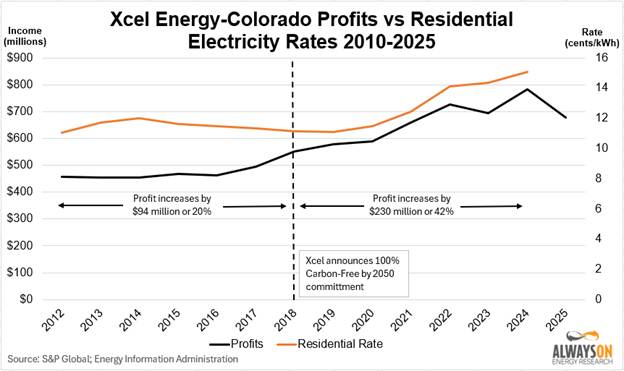
Unfortunately, only Xcel seems to have benefited, as consumers have been saddled with rising costs while Xcel’s profits have risen substantially in recent years. The graph below shows Xcel Energy’s profits in Colorado compared to the residential electricity prices. Since 2018, the utility’s profits have increased by 42 percent since 2018, and rates began their upward trajectory in 2019.
Xcel’s Self-Imposed Resource Adequacy Problems
Xcel’s reliability issues stem from years of advocating for a 100 percent carbon-free electricity grid, which necessitated the closure of reliable generators, such as coal plants, that the company now claims it needs in the coming years to mitigate reliability risks.
However, the company’s 2018 messaging did not clearly communicate the reliability risks associated with its advocacy efforts. After Xcel announced its carbon-free electricity initiative, Xcel’s then-environmental policy manager, Nick Martin, explained, “As the economics of clean energy have improved, it became clearer that we could meet more aggressive goals without sacrificing affordability or reliability for our customers.”
The Comanche Report has determined that this was incorrect.
Since then, Xcel has consistently accelerated its plan to exit from coal and build new wind and solar facilities, and publicly supported clean energy legislation in multiple states.
In Colorado, specifically, House Bill 19-1261—also known as the Climate Action Plan—and Senate Bill 19-236 were signed into law by Colorado Governor Jared Polis on May 30, 2019, which collectively set out targets for Colorado to reduce its greenhouse gas emissions by 80 percent by 2030 and made it mandatory for electric utilities like Xcel to file clean energy plans to pursue a clean energy transition.
Xcel supported these initiatives, and when it filed its Clean Energy Plan in 2021, it explained that these policies “established a pathway and guidance for large regulated utilities to achieve the same goals we announced using Colorado’s ERP process.”
When Xcel’s Clean Energy Plan was eventually passed in 2022, it had accelerated the retirement of several coal facilities, including Comanche Unit 3, from 2070 to 2030—40 years earlier than scheduled and only 20 years after being placed into service.
At the time, Xcel noted it would also seek to “add ‘always available’ power sources to help back up wind and solar and maintain grid stability and reliability,” but the company appears to have underestimated the implications of the policies it advocated for and supported.
Xcel has proposed several new natural gas plants in the state, but Colorado policymakers, regulators, and environmental groups have instead pushed for more wind, solar, and storage, arguing that natural gas would be a sunk cost given the state’s emissions-reduction mandates.
This wasn’t just the strategy in Colorado. Xcel supported clean legislation in Minnesota and coal retirements in New Mexico and Texas, as well. In fact, a 2022 investor’s new release from Xcel noted the following:
Retiring coal generation while continuing to add reliable and affordable clean energy sources are key to Xcel Energy’s strategy in the eight states it serves.
To summarize: Xcel not only supported legislative efforts to close down coal power plants and build unreliable generators, but its own company goal of 100 percent carbon-free electricity preceded them. And now, because of these efforts spearheaded by Xcel itself, reliability has been undermined in Colorado to the point that the same company is noting how critical these coal assets are for reliability.
No Scenario Meets Reliability Standards
In the Comanche Report, Xcel analyzed reliability for several scenarios: one without Comanche units 2 and 3, a baseline scenario that extends Unit 2 through the end of 2026 and repairs Unit 3 in 2026, and scenarios A—D that have different extensions for the Comanche units and that include other small retirement delays and additions.
Shockingly, as shown in the figure below, no scenario maintained reliability above the industry standard of 0.1 days/year Loss of Load Expectation (LOLE), meaning the utility could expect a loss of load once every 10 years. As the company notes:
“Looking closely at the Company’s loss of load probability analyses, the various sensitivities indicate substantial risk in the next two years. Under all analyzed scenarios, the Company’s loss of load probability exceeds the planning standard of less than 0.1. In some cases, the loss of load probability is over 10 times greater than planning best practices.”
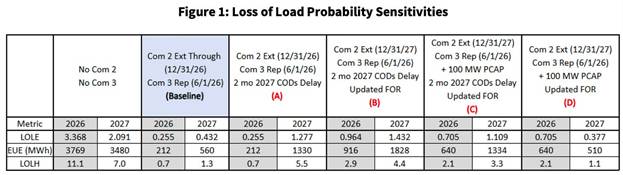
The table above clearly demonstrates that resource adequacy has been compromised by the shift away from thermal capacity, in this case, coal-fired power plants, toward a grid that is increasingly powered by wind, solar, and storage to meet emissions reduction targets and pursue an energy transition.
These findings may surprise Coloradans who believed Xcel when it said it could reliably and affordably pursue an energy transition to reduce emissions. As stated in its Clean Energy Plan in 2021:
After many years of technical and system advancements, we are able to confidently present for consideration by the Colorado Public Utilities Commission (“Commission”) a plan that would achieve by 2030 an estimated 85 percent reduction in carbon dioxide emissions from 2005 levels and deliver nearly 80 percent of our customers’ consumed energy from renewable resources. What makes this plan even more extraordinary is it accomplishes these objectives without compromising the Company’s longstanding focus on reliability and affordability.
While Xcel customers have not benefited from the company’s energy transition, with electricity prices rising and the company warning of reliability risks, the company has succeeded in growing its profits for shareholders.
Rate Base Rising
Xcel’s investor presentation conveys the significant financial gains the company has already reaped from its policy advocacy and demonstrates how carbon-free mandates will likely increase its rate base in the future.
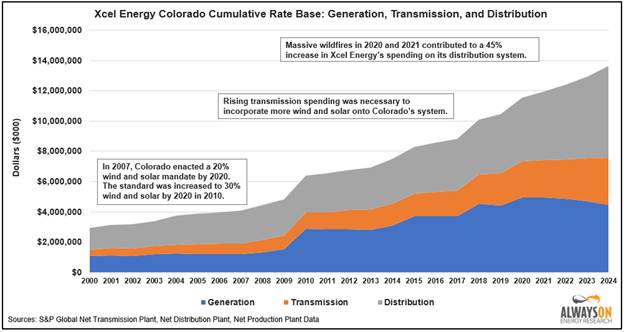
Based on S&P Global data for the Public Service Company of Colorado (PSCo), Xcel’s Colorado service territory, spending on generation, transmission, and distribution has surged nearly threefold, from $4.8 billion in 2009 to $13.6 billion in 2024. This figure is roughly commensurate with the $12.5 billion estimate reported by the Colorado Public Service Commission.
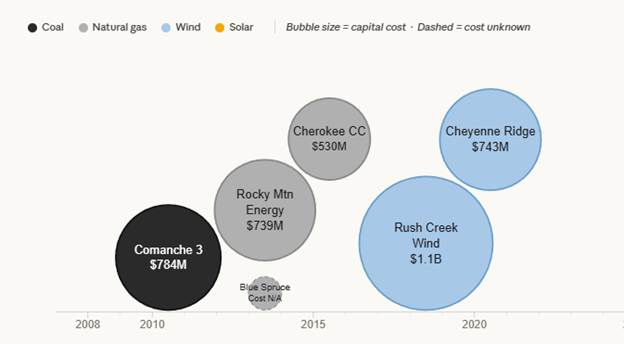
The timeline below shows major capital expenditures in the generation category by plant and cost. The increases in 2010 can be attributed to the addition of the Comanche 3 coal facility. Xcel also acquired two natural gas plants from Calpine in the early 2010s and converted the Cherokee coal plant to natural gas. The rate base increased again in 2018 when the Rush Creek Wind facility came online, and again in 2020 with the addition of the Cheyenne Ridge Wind facility.
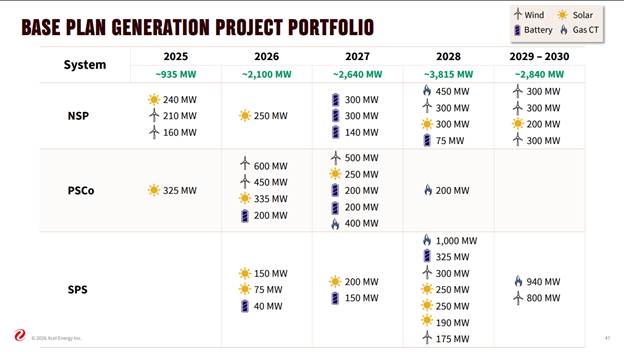
Looking ahead, Xcel plans to spend substantial sums on solar, wind, battery storage, and transmission lines in accordance with the policies it helped create.
From 2025 through 2028, Xcel is projected to build 901 MW of solar, 1,550 MW of wind, 600 MW of battery storage, and just 600 MW of new natural gas in its Public Service Company of Colorado territory, shown below as PSCo.
These malinvestments will lead to substantial growth in Xcel’s rate base.
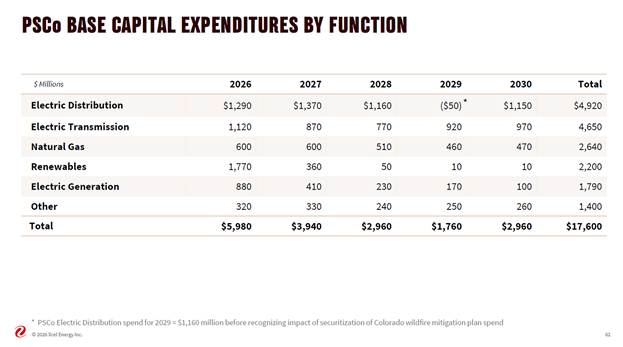
Slide 62 from Xcel’s investor presentation shows the company’s PSCo rate base will increase by $17.6 billion in the next five years, as the company spends $4.9 billion on distribution upgrades, $4.65 billion on transmission upgrades, including its Colorado Power Pathway project, $2.2 billion on renewables, and $1.79 billion on “electric generation,” which we are told is a euphemism for new natural gas plants.
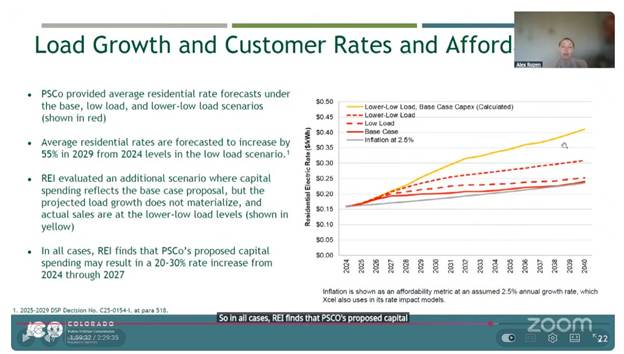
A recent webinar by the Colorado Public Utilities Commission shows a range of potential rate outcomes from Xcel’s spending plans. Rate hikes could be modest if load growth is substantial, but if load growth comes in below the forecast, Xcel’s own rate forecasts suggest this buildout could cause residential electricity prices to skyrocket by 55 percent in 2029, compared to 2024 levels.
Colorado voters are reaping the consequences of the energy policies their elected officials voted to enact, and that Xcel Energy lobbied for and shaped throughout the legislative process.
Conclusion
Xcel Energy’s current reliability dilemma can be described as a self-inflicted wound from decades of self-serving policies.
Perhaps Xcel thought they could “feed the crocodiles” by funding green advocacy groups and lobbying for carbon-free mandates, shut down their coal plants, and then reap the financial reward of building new natural gas plants as the company’s reserve margins dwindled downward.
However, the new gas plants were blocked by the very interest groups Xcel helped cultivate, and now the company will be lucky to make it through the next few years without blackouts. If there are blackouts, there will be backlash, and Xcel will deserve the criticism it receives.