
In a November 8th, 2025, interview with the New York Times, Calvin Butler, the CEO of Exelon, one of the largest utilities in the United States, quipped that the best hack for lowering your electric bill is to turn off your lights.
The notion that Americans can save money on their power bills by simply consuming less electricity is pervasive among climate activists, organizations that push for wind, solar, and energy-efficiency/demand response mandates, and utility executives who are seeking ways to avoid some of the public backlash of rising electricity bills by shifting the blame back to consumers for using electricity.
However, this energy efficiency messaging is, at best, outdated and, at worst, intentionally misleading.
The notion that energy efficiency can save consumers money will become increasingly obsolete in the coming decades if utilities prioritize power plants with no or low fuel costs, such as wind, solar, battery storage systems, and nuclear power plants, because these energy sources effectively destroy the financial incentive to conserve electricity compared to coal and natural gas power plants.
Bills, Rates, and Revenue Requirements
Before we discuss why certain generating resources facilitate energy efficiency savings and why others erode their economic underpinnings, we need to understand the basic math that governs the majority of residential electric bills. The simplified formula is:

Usage is the customer’s total kilowatt-hour consumption in a month, and in our simplified formula, rates are the volumetric price charged per kWh consumed.1
Electricity rates are determined by the following relationship:

The revenue requirement is the total amount of money a regulated utility must collect from customers to cover its operating expenses, such as fuel costs, capital costs (including a return on invested capital), depreciation, and taxes over a given period.
Projected sales are the total number of kilowatt-hours the utility expects to sell across its territory.
At first glance, these formulas suggest that customers can lower their bills by either decreasing electricity rates or by conserving electricity and using less power.
Electricity rates are largely outside of the hands of customers on a day-to-day basis and depend on either a decrease in revenue requirement or a rise in projected electricity sales, which means that the only real option to lower bills for the average customer is to conserve power. However, this only works if the drop in usage corresponds to a decrease in revenue requirements, and this leads us to why the math for high fixed-cost grids no longer works when it comes to conserving energy to save money.
The New Math: Why Energy Efficiency Won’t Save You Money
On the traditional fuel-heavy grid, it was possible for energy efficiency programs to save consumers money because every kWh not consumed meant less coal or natural gas burned, lower fuel expenses, and lower variable operations and maintenance (O&M) expenses.
In contrast, in regions with high wind, solar, and storage penetrations, the system is dominated by upfront, fixed capital and financing costs, with effectively zero marginal costs. While wholesale energy markets reward wind and solar generators because they have virtually zero marginal costs, it also means these resources have few avoidable costs once they are built. Utilities and plant operators need to recoup the costs of these facilities, regardless of how much energy is consumed.
To demonstrate, the graph below shows that existing coal plants in the Midcontinent Independent System Operator (MISO) region have total average costs of $40.31 per MWh, and new wind and solar have total costs of $47.53 and $64.69 per MWh, respectively, based on 2024 FERC Form 1 Filings and the Energy Information Administration (EIA) assumptions to the Annual Energy Outlook (AEO).
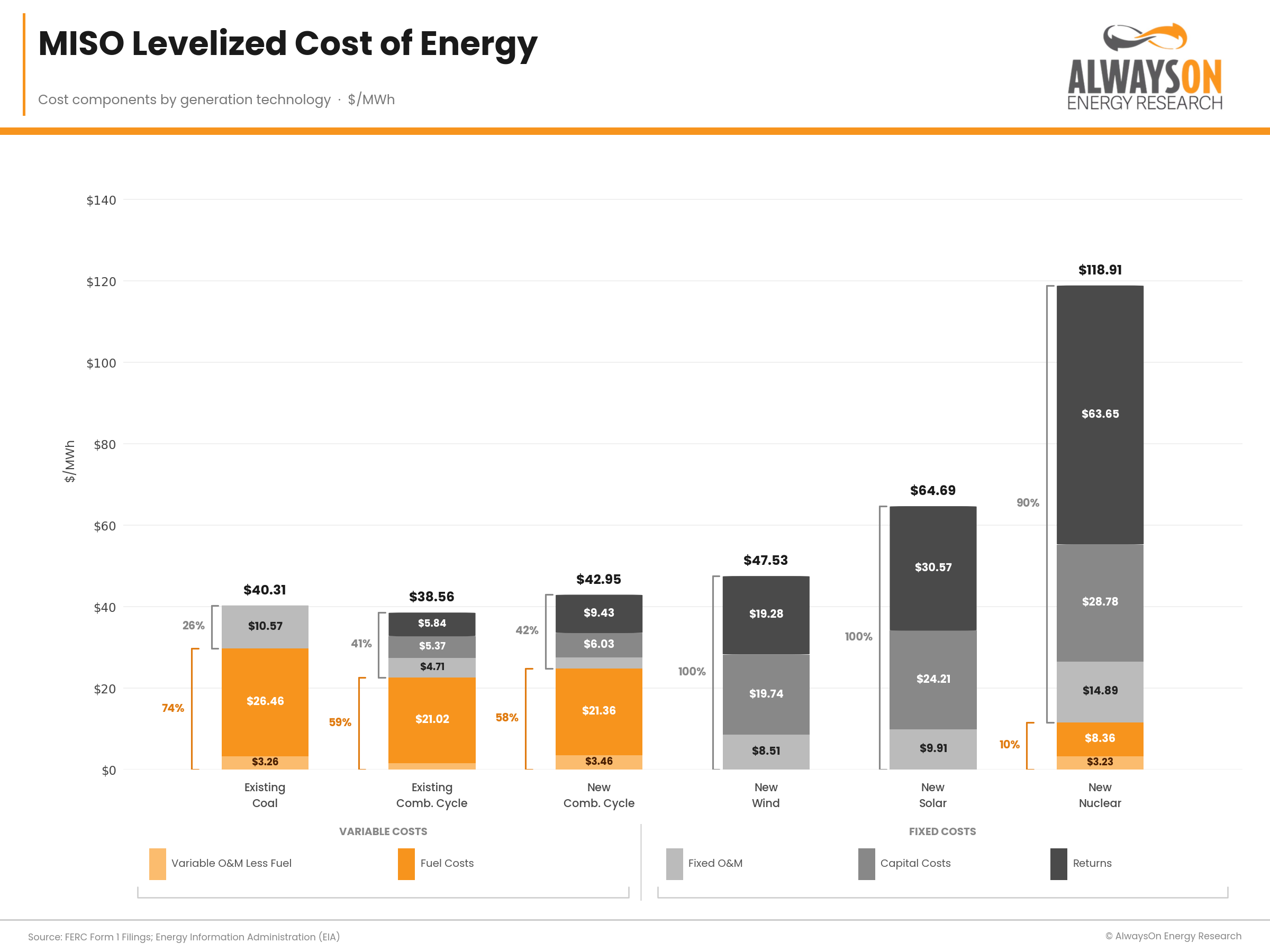
For coal plants, $26.46 are fuel costs, $3.26 are variable operations and maintenance, and the remainder is fixed costs that are unavoidable, meaning 74 percent of the total cost of existing coal in MISO is variable cost. As a result, reducing your electricity consumption can meaningfully reduce the utility’s revenue requirement. The same is true for existing and new combined cycle plants, where 58-59 percent of the costs are variable.
Wind and solar are just the opposite, with 100 percent as fixed costs, according to EIA assumptions in the AEO, and costs for new nuclear facilities are 90 percent fixed. This means you can wear as many sweaters as you like to reduce electricity consumption, but you cannot reduce the utility’s revenue requirement by conserving energy because these costs will simply be recouped by recovering the same revenue requirement from fewer kWhs sold, resulting in rising electricity rates and steady, if not rising, electricity bills.
This dynamic is frequently referred to as revenue decoupling, and it has been documented for more than a decade in states with aggressive efficiency programs.
Decoupling: Heads I Win, Tales You Lose
To protect utilities from revenue loss due to efficiency-driven sales reductions, regulators in many states have adopted “decoupling” mechanisms.
Under decoupling, utilities are guaranteed their authorized revenue requirement regardless of actual sales volume, breaking the historic link between revenue and volumetric sales. If sales fall below projections, rates are adjusted upward through periodic true-ups; if sales exceed projections, rates are adjusted downward. The utility’s revenue is decoupled from the volume of electricity sold.
According to the ACEEE 2025 State Energy Efficiency Scorecard, 19 states plus the District of Columbia have full or strong revenue decoupling mechanisms for electricity utilities. Another approximately 10–13 states operate partial mechanisms, most commonly Lost Revenue Adjustment Mechanisms (LRAM), which recover some—but not all—of the lost revenue from efficiency programs.
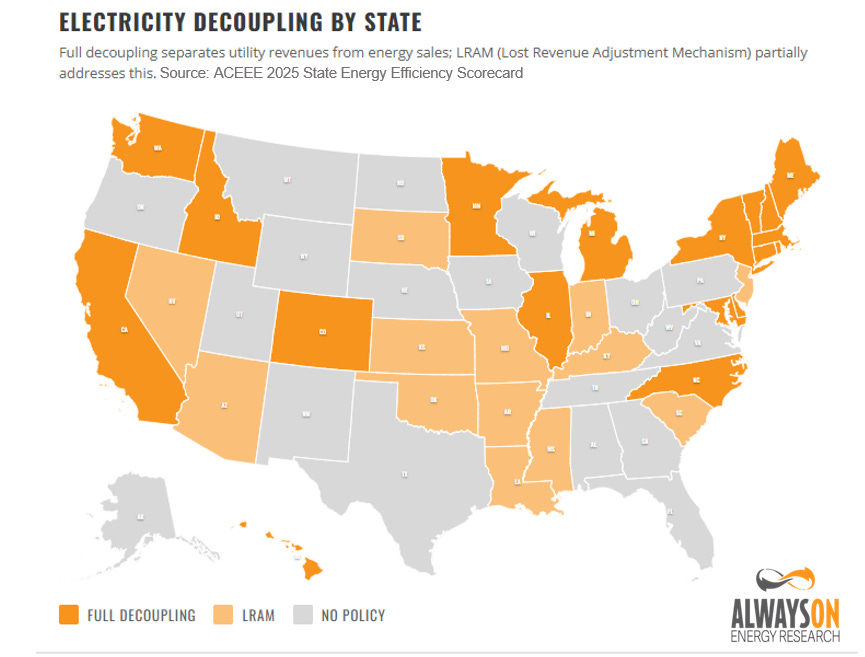
In these jurisdictions, efficiency programs are explicitly designed to reduce sales while the regulatory framework ensures that you, dear reader—not the utilities—suffer financially.
The practical result is that energy savings (lower kWh) do not translate into monetary savings for customers.
For example, as shown in the chart below, residents in the 19 jurisdictions with full decoupling mechanisms in place decreased the average customer monthly electricity usage by 7.7 percent since 2008, while their bills have increased by 60 percent. Essentially, residential customers are paying more for less electricity.
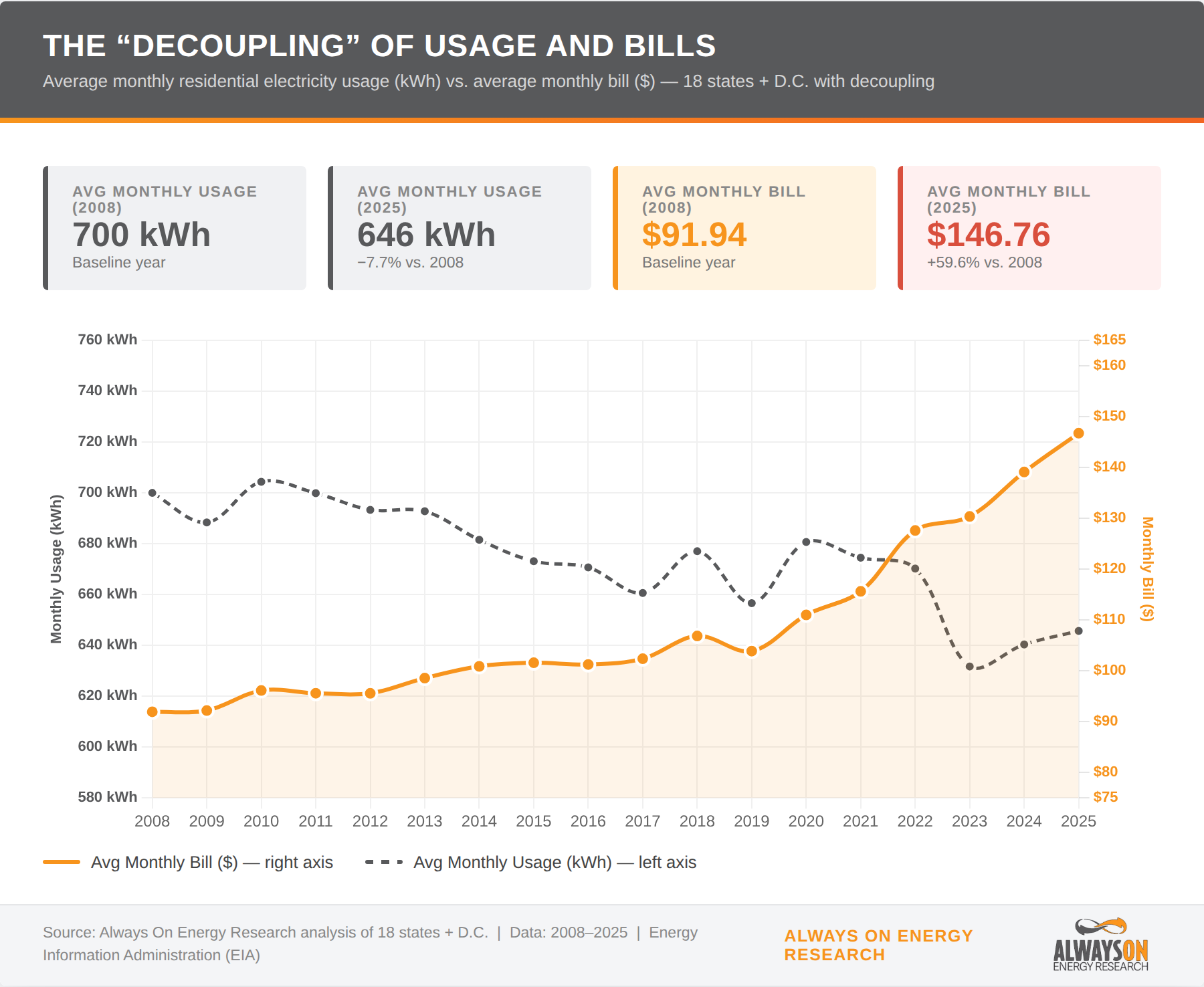
While the same trend is true for the rest of the country, these 19 decoupling jurisdictions show it much more pronounced, as they decreased monthly usage by 94 percent more than all other states in the U.S. since 2008, yet bills increased by 50 percent more.
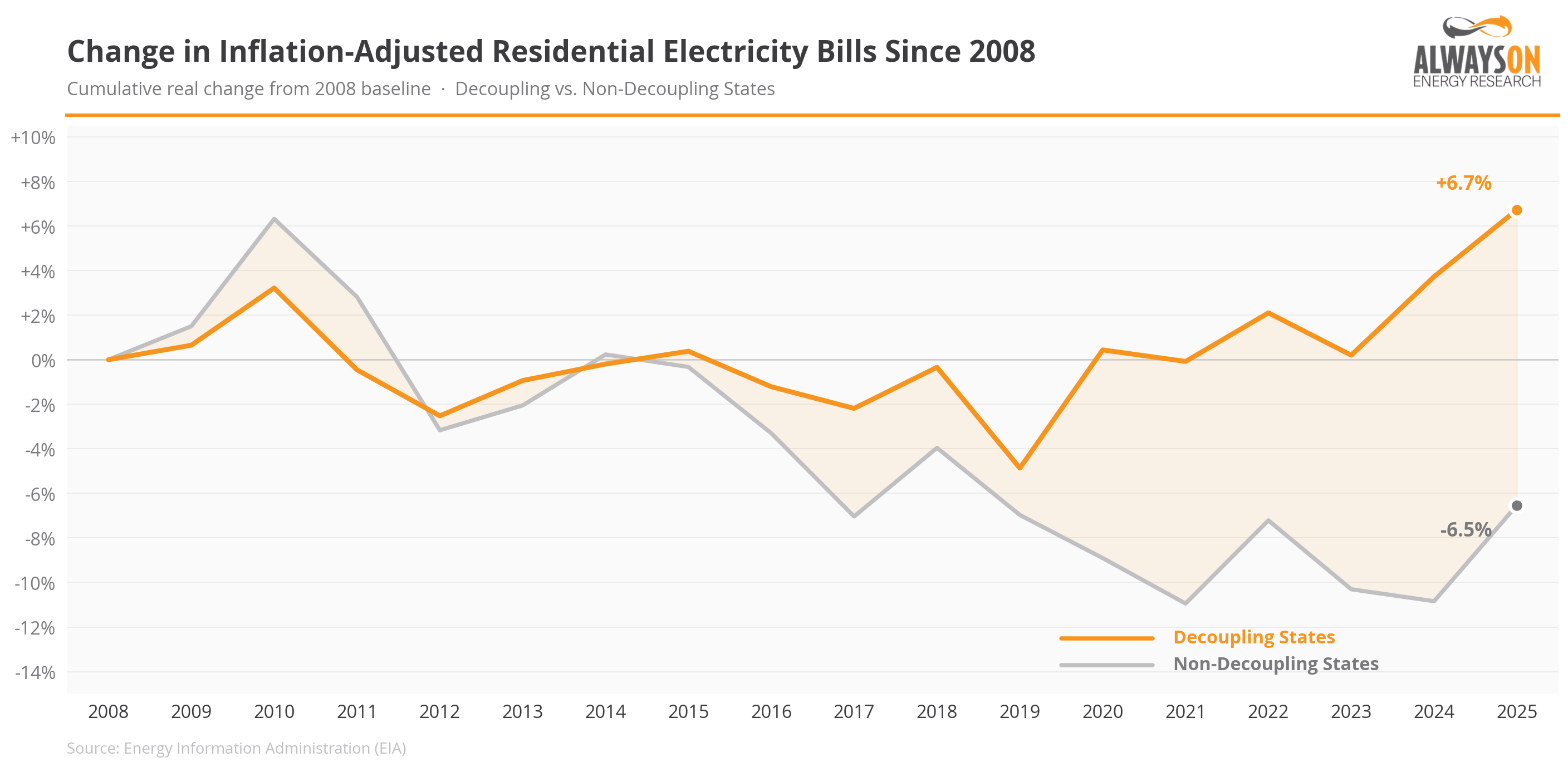
In other words, these jurisdictions saw greater electricity conservation than other states, yet bills still increased by a larger percentage. This holds when adjusting for inflation, as well. Whereas states without decoupling have seen electric bills fall by 6.5 percent in inflation-adjusted values, electric bills in decoupling states and D.C. have increased by 6.7 percent—again, even though electricity usage has decreased more in these areas.
Rate Basing Efficiency Spending
In a handful of states (Illinois, Maryland, New York, and Utah), utilities are even permitted to capitalize certain energy efficiency expenditures and add them to the rate base, earning a regulated return on equity just as they would on a new power plant or transmission line.
This turns efficiency programs into a profit center for the utility while the costs are recovered from all ratepayers over many years.
Combined with decoupling, this creates a situation in which utilities have strong financial incentives to promote efficiency programs even when those programs deliver little or no net bill reduction for the average customer.
And in the end, if energy efficiency programs aren’t benefiting customers by lowering their electricity bills, what good are these programs in the first place?
Conclusion
Despite the claims of wind and solar advocates, energy efficiency will not save you money in the long run, because their preferred energy sources, and the ones making up most of the capacity queues across the country—mainly, wind, solar, and batteries—have primarily fixed costs that do not allow for savings.
Energy efficiency still produces lower total kWh consumption. It does not produce lower bills for most customers in a fixed-capital, near-zero-marginal-cost grid. The old claim that efficiency is the cheapest resource was accurate when the dominant cost was fuel.
That world is slowly fading.
The math has changed. The claims have not.
- There are several different components of an electricity rate, including base charges, fuel riders, various policy riders, and low-income adjustments. The EIA does not account for these subcomponents. Rather, EIA’s rates are simply total costs divided by kWhs sold. ↩︎