Regulators price the damage from a ton of carbon dioxide but assign no cost to a grid that fails when people need it. That gap lets policymakers count the climate benefits of retiring dispatchable generation while ignoring the cost of the blackouts that follow.
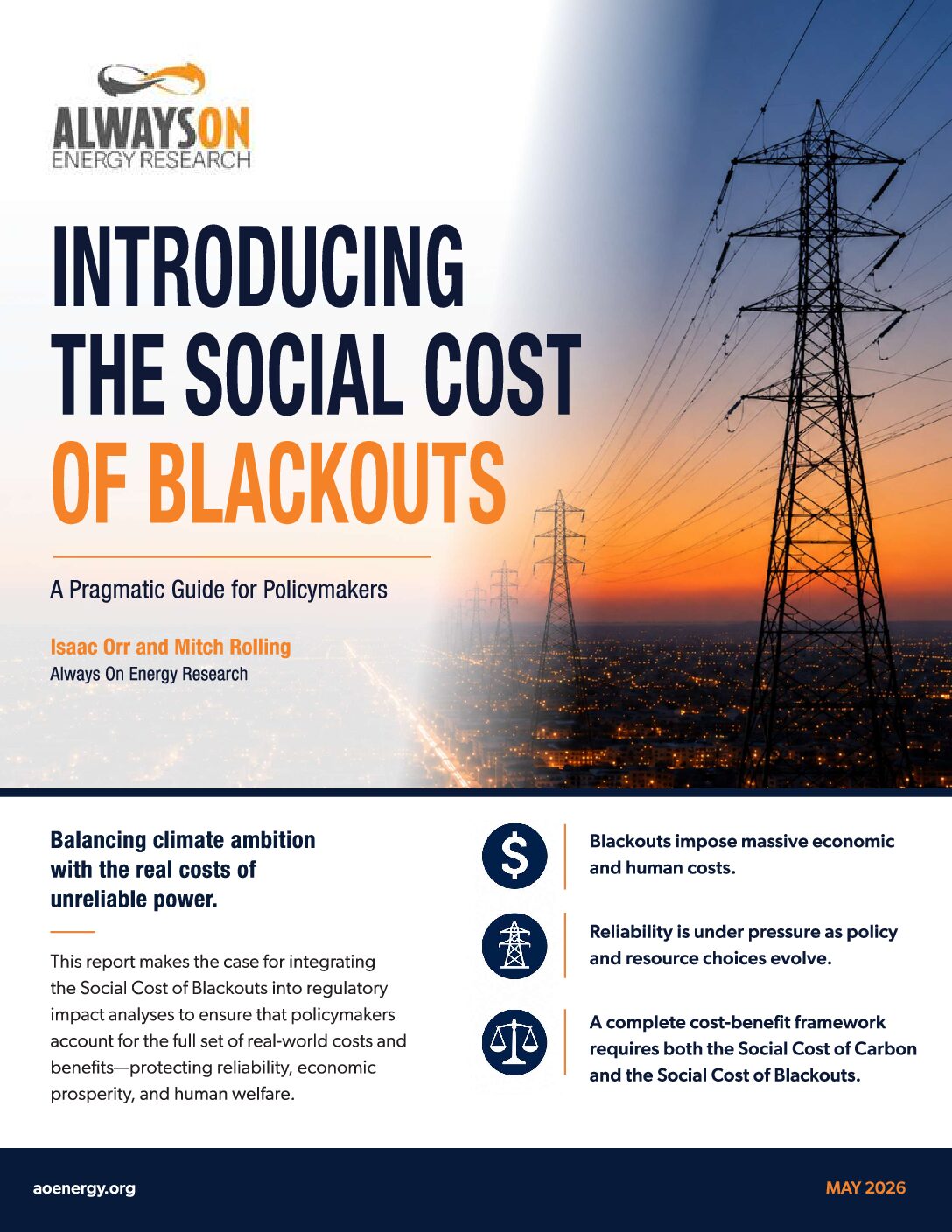
Always On Energy Research is pioneering research Introducing the Social Cost of Blackouts, which quantifies the economic and human costs of power outages caused by regulation. Federal and state regulators routinely apply the Social Cost of Carbon (SCC), a forward-looking estimate of the damage from each incremental ton of emissions, in rulemakings and integrated resource plans. No equivalent metric prices the outages those same rules produce. The report builds one using tools the government and industry already rely on, including the Lawrence Berkeley National Laboratory’s Interruption Cost Estimate (ICE) calculator and standard reliability metrics (SAIDI, SAIFI, CAIDI).
The report applies the method to the Biden EPA’s Final Carbon Rules in the Southwest Power Pool (SPP), using the EPA’s own Integrated Planning Model assumptions and stress-testing the resulting grid against actual hourly wind and solar performance from 2019 through 2023. The results undercut the rule’s economic case:
- Blackouts occur in every historical weather year tested. The 2021 weather year alone produces over 8.3 million MWh of unserved energy through 2055.
- SPP blackout costs run $106 billion to $402 billion through 2047, discounted at the EPA’s own 2 percent rate, against EPA-calculated net benefits of $370 billion for the entire rule nationwide.
- In the worst-case weather year, blackout costs turn the rule’s national net benefits negative, to -$32 billion. Even the best case erases 29 percent of national net benefits, from a region serving just six percent of Americans.
- Blackout costs reach $395 per ton of CO₂ averted in the worst case, 58 percent above the Biden administration’s $250 SCC.
The report lays out a seven-step process any agency can replicate and recommends that the EPA and other federal regulators be required to apply the Social Cost of Blackouts in their cost-benefit analyses, coordinating with FERC and DOE on reliability risk before finalizing a rule. A regulation that prices one externality and ignores the other gives policymakers half the math.
Read the full report, Introducing the Social Cost of Blackouts, at this link. Direct media inquiries to [email protected].