
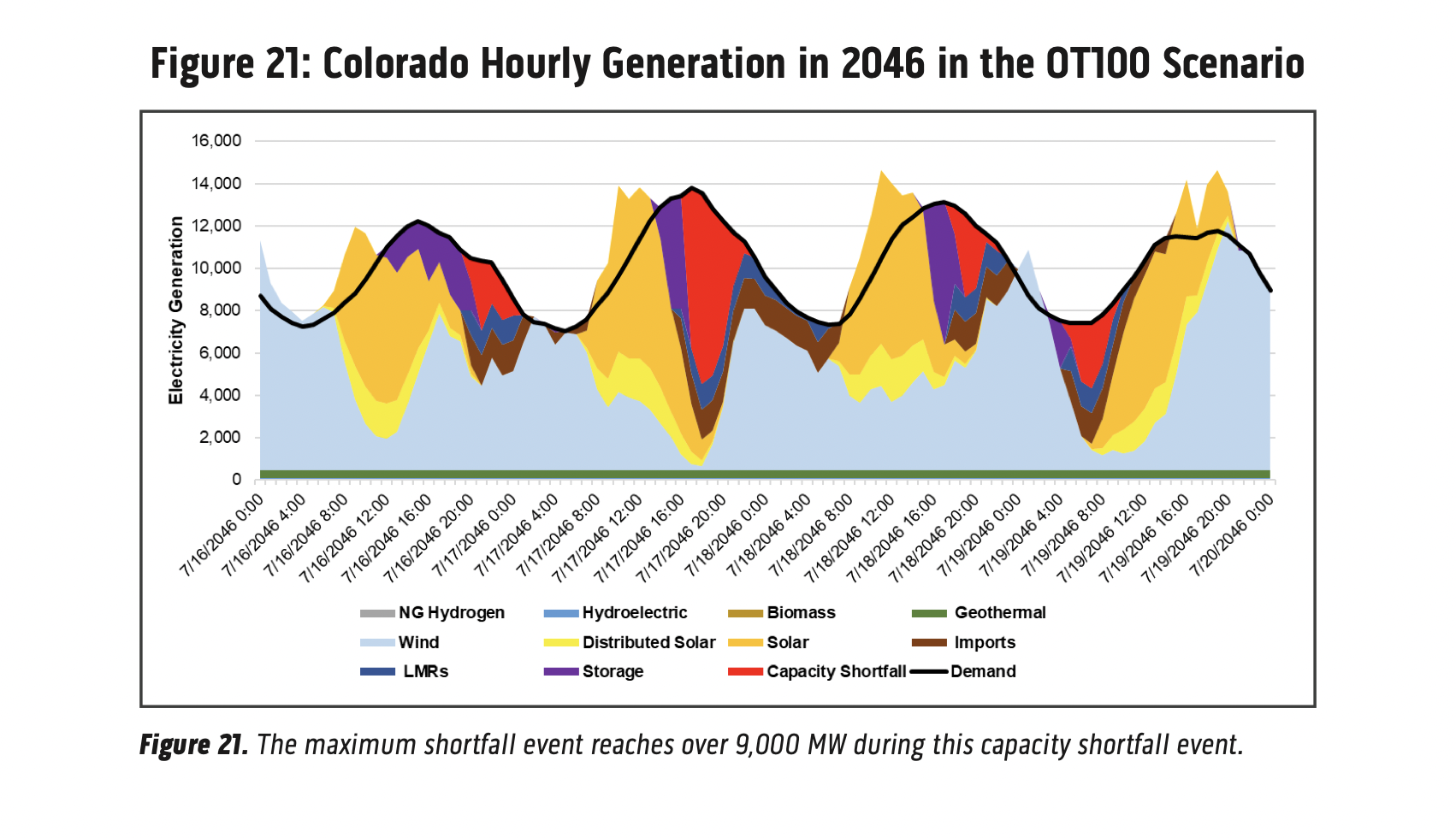
The Independence Institute released Colorado’s Green Hydrogen Boondoggle, authored by AOER’s Isaac Orr and Mitch Rolling. The paper stress-tests Colorado Energy Office’s Ascend Analytics’ “Optimized 100” (OT100) scenario, a 2040 zero-emissions path that leans on wind/solar, 12-hour batteries, and “green hydrogen,” against real-world costs and reliability. The verdict: OT100 is too expensive, and it breaks the grid.
Key findings
- Cost blowout: OT100 adds $114.3B through 2040 (or $56.6B discounted at 6%). Ascend undercounts transmission and relies on optimistic capital expenditures and hydrogen assumptions.
- Rate shock: Average prices more than double to 27.94¢/kWh by 2040.
- Reliability failure: OT100 leads to blackouts as early as 2040, with later events lasting up to 66 hours.
- Workable alternatives: A Natural Gas path meets load with $9.5 billion added cost through 2040 and no blackouts. A portfolio that includes nuclear cuts emissions ~90% with a $37 billion price tag through 2040 and no blackouts.
Why the gap? System costs that glossy LCOE charts ignore—overbuild, long-distance transmission, balancing/backup, and much higher hydrogen utilization than assumed—drive OT100’s price tag and outages. In practice, you’re paying for a vast new system that still can’t keep the lights on during wind/solar droughts.
Bottom line: Colorado can deeply decarbonize and keep power affordable and reliable—but not with OT100.