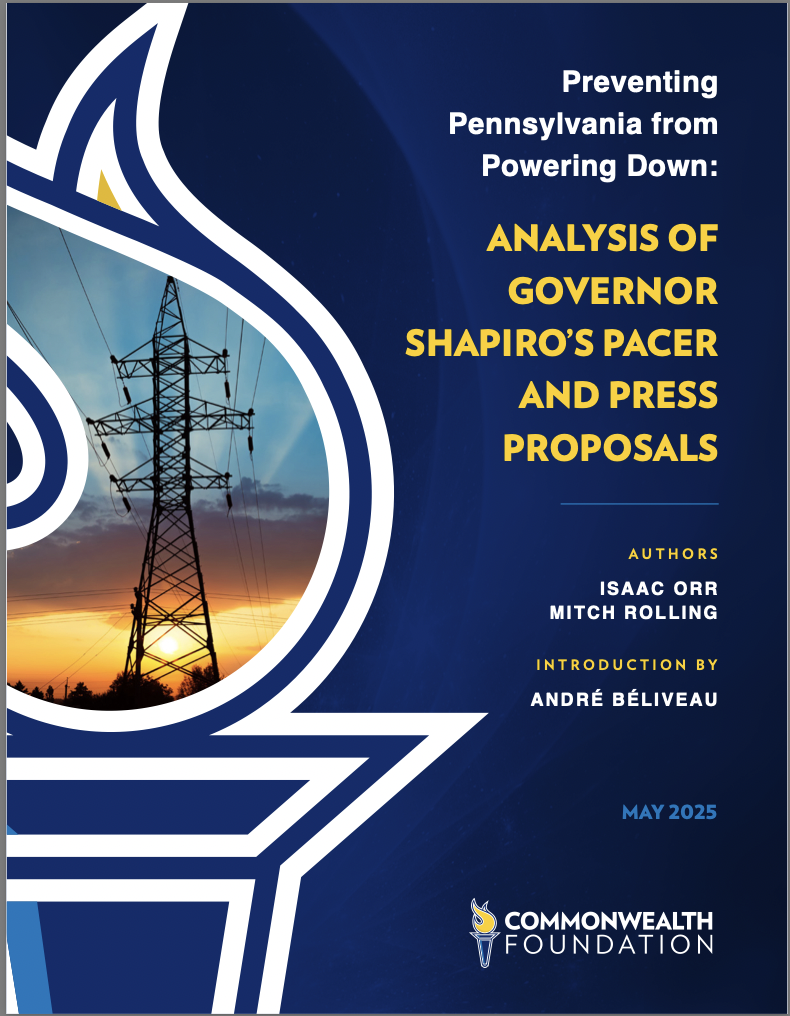
AOER co-founders Isaac Orr and Mitch Rolling authored a report, Preventing Pennsylvania from Powering Down: An Analysis of Governor Shapiro’s PACER and PRESS Proposals, commissioned by the Commonwealth Foundation. The study examines the projected cost and reliability impacts of Democrat Governor Josh Shapiro’s two signature climate initiatives: the Pennsylvania Climate Emissions Reduction Act (PACER) and the Pennsylvania Reliable Energy Sustainability Standard (PRESS).
Despite campaigning on a healthy skepticism of the Regional Greenhouse Gas Initiative (RGGI), a multistate cap-and-trade carbon tax, Shapiro introduced PACER to establish a state-specific version of RGGI. It would set strict carbon emissions limits for thermal power plants and charge a fee for each ton of emissions. At the same time, PRESS would greatly expand Pennsylvania’s portfolio of alternative, intermittent energy generation.
Together, PACER and PRESS would significantly raise electricity costs while increasing the grid’s reliance on unreliable, weather-dependent resources. AOER’s proprietary modeling shows that if enacted, PACER and PRESS would add $157 billion in electricity costs by 2035, pushing average rates 60 percent higher, from 12.6 cents per kWh to 20.2 cents per kWh. Household bills would more than double, increasing $1,754 annually, while commercial and industrial consumers would face even steeper cost hikes.
The consequences would extend far beyond Pennsylvania. As the third-largest electricity producer in the nation and its largest exporter, Pennsylvania currently supplies about 35 percent of the power it generates to other states. Its diverse fleet of natural gas, nuclear, and coal plants plays an indispensable role in maintaining reliability across the Eastern Interconnection. Weakening that fleet through policies like PACER, PRESS, and RGGI would ripple across regional grids—raising costs, reducing reliability, and undermining one of America’s most important states for affordable, dependable energy.