In 2009, the United States surpassed Russia as the world’s largest natural gas producer, driven by surging production from the shale boom and a substantial increase in natural gas pipeline construction.
However, since 2017, further increases in gas production in some parts of the country have been restrained by a lack of interstate pipelines to move gas from where it is produced to where it is consumed. The lack of new pipelines resulted from an increasingly politicized permitting process, where run-of-the-mill environmental reviews, such as Clean Water Act permits, were used to delay projects to death in hopes of keeping the gas in the ground.
It was not to be, however, as Big Tech appears to have noticed the red tape around interstate pipelines and has shrewdly sidestepped it by building natural gas power plants in the states where the gas is produced, avoiding many of the headaches of interstate oversight.
Today, we explore how pipeline opposition in some states, mostly those of a blueish hue, has led to a massive increase in planned data-center-dedicated natural gas plants in the states where the gas is produced.
Traffic Report: A Slowdown on Interstate Pipeline Construction
U.S. Energy Information Administration (EIA) data show a large increase in interstate pipeline capacity from 2006 through 2009, and again from 2011 through 2017. These increases correlate roughly with the surge in natural gas production in the Barnett shale of Texas in the mid-2000s and the steep production increases in Appalachia in the 2010s.
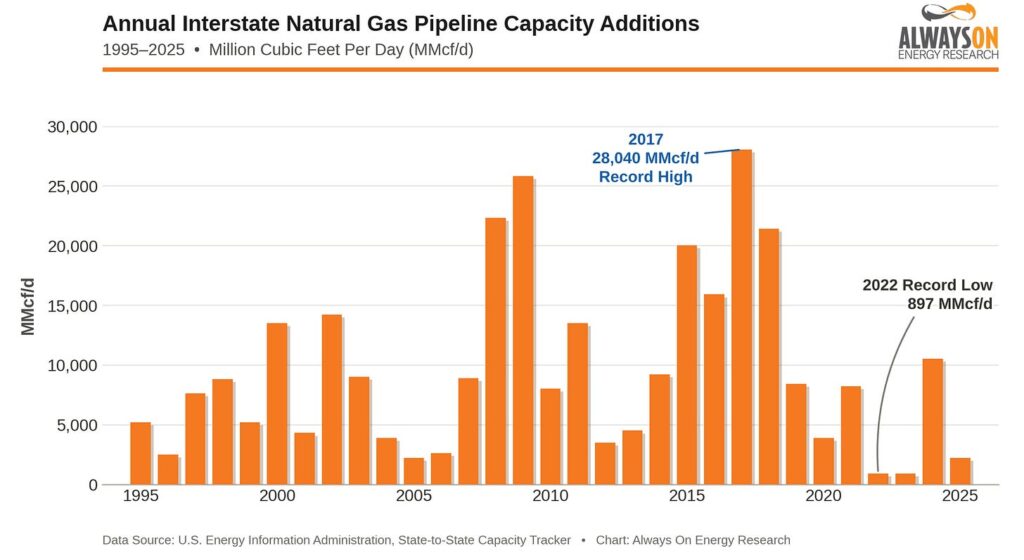
However, by the mid-2010s the sledding had become much more difficult for interstate natural gas projects. Once a sleepy, nearly foregone conclusion at the Federal Energy Regulatory Commission (FERC), pipeline approvals became increasingly contentious as state officials and climate groups used permitting and litigation to constrain new natural gas infrastructure.
Pipeline opposition became particularly strong in the Northeast United States, where governors attempted to delay projects to death by refusing to issue Clean Water Act 401 permits, and litigation from attorneys general and climate groups has chilled the investment environment.
Our friend Ken Girardin reports that former New York Governor Andrew Cuomo pioneered the playbook: delay and deny pipeline permits until the project dies. Cuomo’s efforts to kill the Constitution Pipeline were successful in denying New England access to natural gas and limiting pipeline capacity out of Pennsylvania.
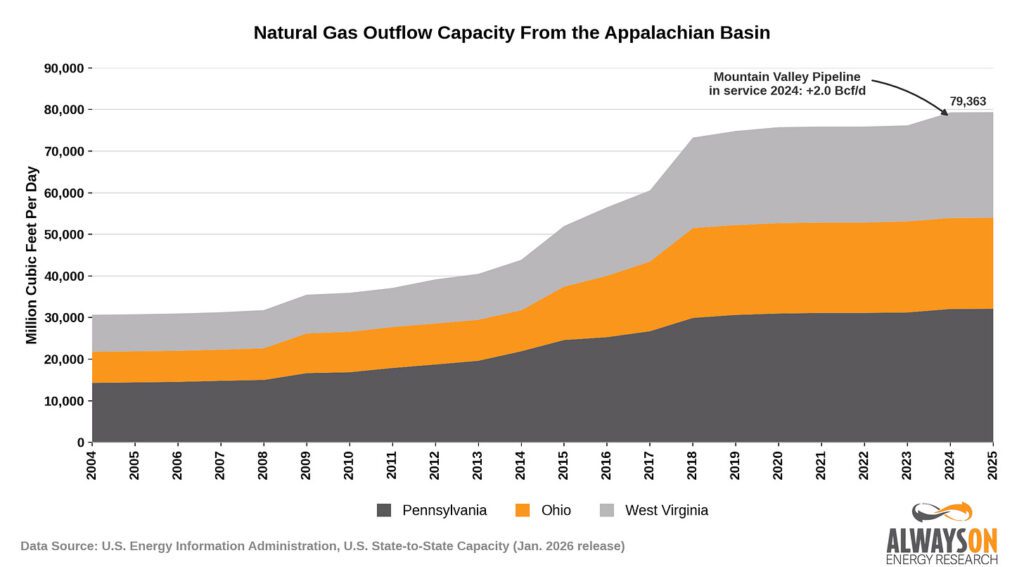
The slowdown in interstate pipelines also affected other Eastern states, like the delay of the Mountain Valley Pipeline (MVP), which runs from West Virginia to southern Virginia.
First proposed in 2014, MVP was designed to transfer 2 billion cubic feet per day of natural gas. The project originally received approval from FERC in 2017, but a combination of lawsuits and permit challenges made construction all but impossible.
The MVP pipeline was approved only because Congress declared completion of the pipeline to be in the national interest, ratified its federal permits, ordered agencies to maintain them, and stripped courts of jurisdiction to review many of the approvals needed to finish the project.
The Cost of Delaying MVP
Delaying projects like MVP has real-world consequences.
The original estimate for the pipeline was around $3.5 billion and was expected to be in operation by 2018. The extensive legal battles that delayed the project contributed to more than doubling the price to just under $8 billion by the end.
Due to the cost increases, existing customers hit the maximum cap on their cost over-run mechanism in their contracts, and future customers will pay higher rates, as the delays prompted MVP to raise its maximum rates by 80 percent or more.
The conclusion of East Daley Analytics sheds more light on why the delay will likely deter investors moving forward with future projects:
From a broader view, the filing with FERC highlights the exorbitant cost to build a greenfield pipeline out of Appalachia and earn a reasonable return. MVP has fought adverse legal rulings since 2018 and racked up $3B in additional costs, according to the filing. A rate of ~$1.80/Dth would be prohibitive for Marcellus and Utica shale gas producers, equal to 150% of current commodity prices in the basin. The high bar shows why another big pipeline project out of the Northeast is unlikely.
Gas Math
Given the mountains that needed to be moved to permit the MVP, it simply makes no sense to build data-center-dedicated natural gas power plants in regions that require new interstate natural gas pipeline capacity.
For example, assume we have a 1,000 megawatt (MW) data center that runs continuously. The facility is powered by a combined-cycle natural gas plant with a heat rate of 6.75 million British thermal units (MMBtu) per megawatt-hour (MWh).
The math works out to:
1,000 MW x 24 hours per day x 6.75 MMBtu per MWh = 162,000 MMBtu, or roughly 0.162 billion cubic feet, per day.
At that rate of consumption, the MVP pipeline could accommodate around 12,300 MW of new natural gas capacity. As we discussed in The Gray New Deal, the ten largest gas plants being built to serve data centers in the United States have a combined capacity of 45,848 MW, or an average of 4,585 MW per facility. So the massive headaches of the MVP pipeline would serve about three of these giant facilities, on average.
Why would anyone go through the hassle of building and financing interstate pipelines when they can just go to the gas?
Data Centers Go Directly To Gas
The data center folks seem to understand their circumstances.
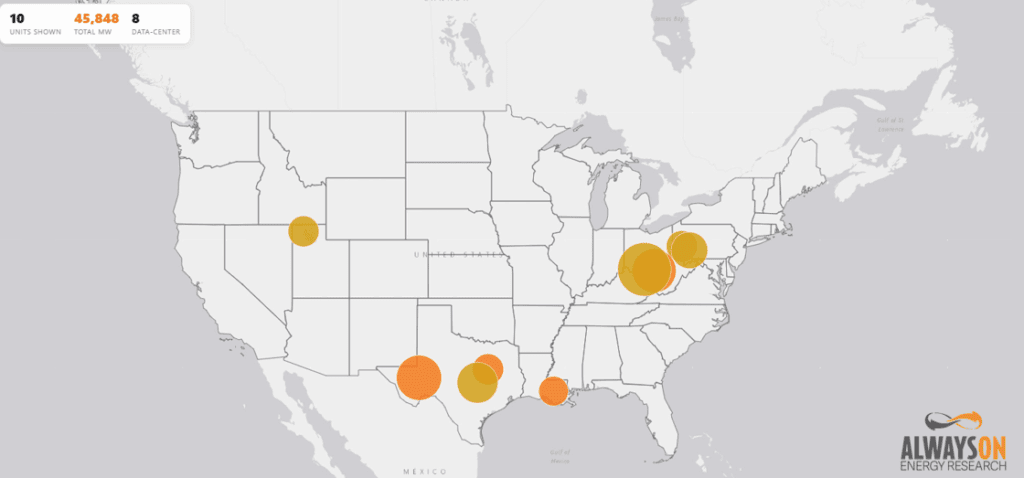
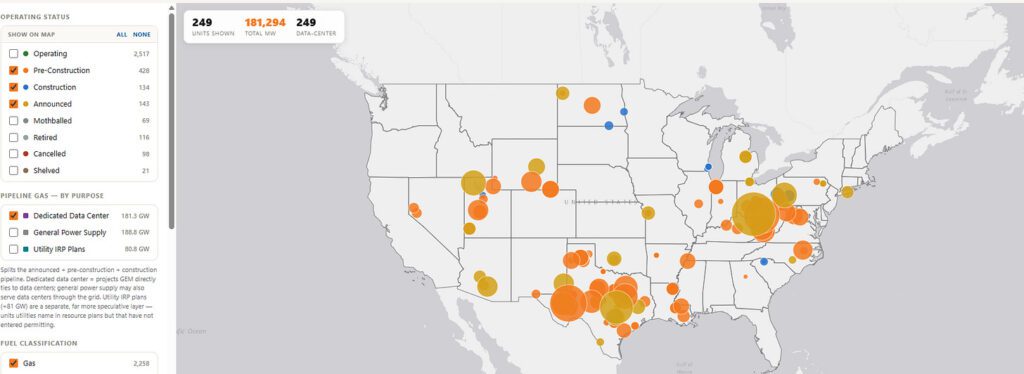
Using data from the Global Energy Monitor (GEM), we constructed a natural gas dashboard that allows users to sort natural gas power plant projects based on whether they are specifically designed to serve data centers. The map shows a cluster of data-center-dedicated natural gas plants in the top ten natural gas-producing states.
These states, in order of production, are Texas, Pennsylvania, New Mexico, Louisiana, West Virginia, Oklahoma, Ohio, Colorado, North Dakota, and Wyoming.
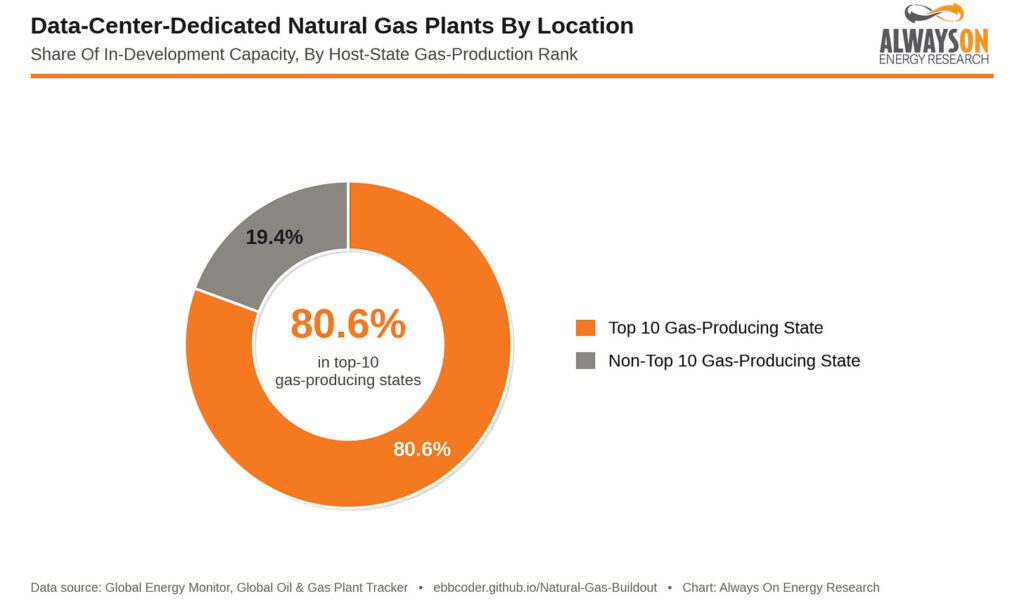
In total, 80.6 percent of the natural gas plants being built to power data centers are in the top ten natural gas-producing states, and those ten states account for 94.5 percent of U.S. natural gas production.
Texas is leading the way. The Lone Star State accounts for 29.3 percent of natural gas production and 42.2 percent of the data center-dedicated gas plants in the GEM database. Pennsylvania has the second-highest share of data center-dedicated gas plants and is the second-largest natural gas producer.
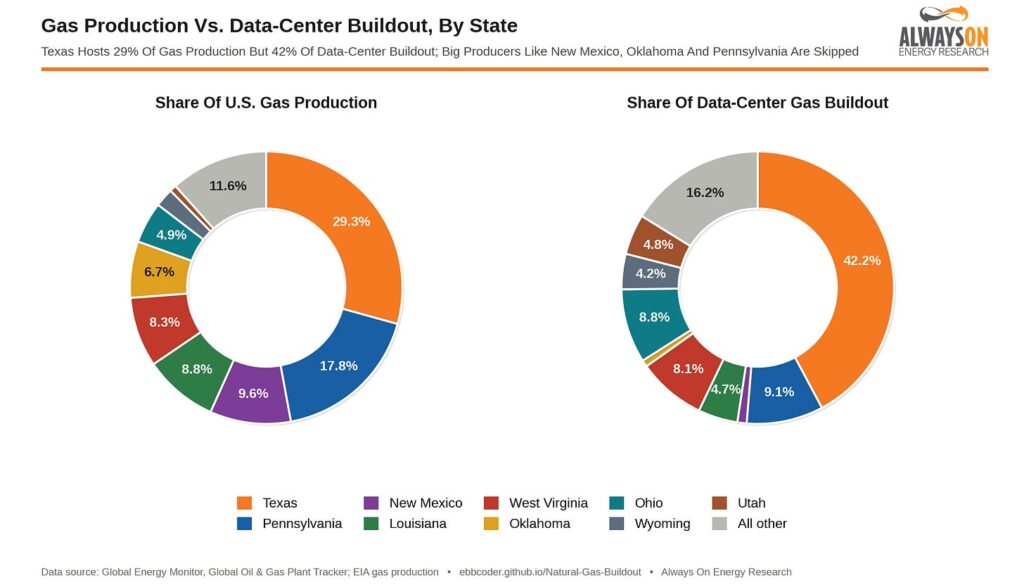
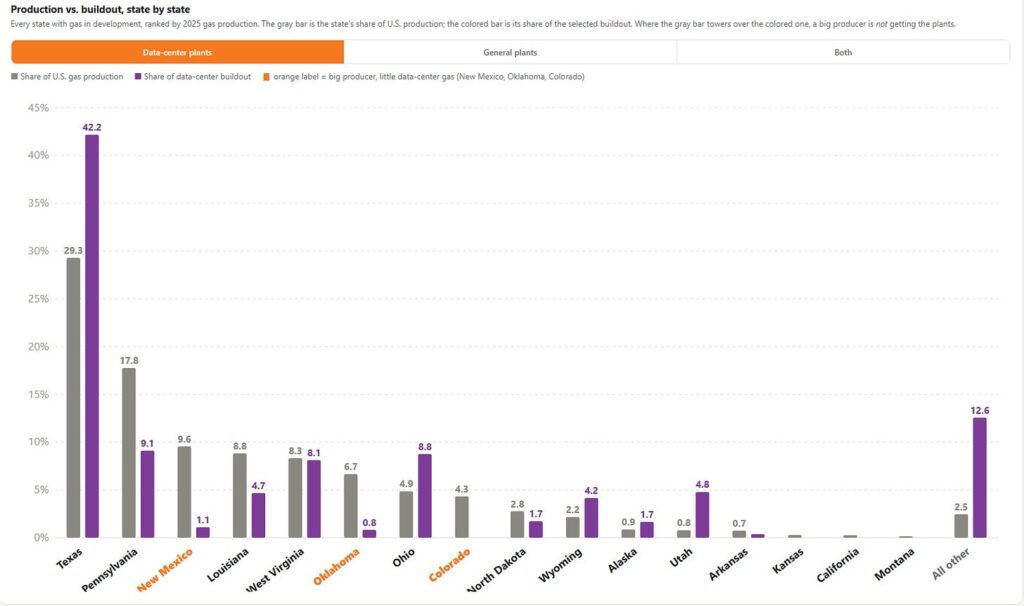
However, it takes two to tango, and some states that produce significant quantities of gas have very little in the way of new natural gas plants being built to accommodate data centers.
The graph below shows a few of these outliers: New Mexico, Oklahoma, and Colorado are substantial gas producers but have a small percentage of announced natural gas plants dedicated to data centers at this time.
Two weeks ago, we detailed how Blue States are projected to build nearly 12 times less natural gas capacity than Red States. A big reason why is because they are more amenable to the needs of businesses that need reliable, always available electricity from dispatchable power facilities like natural gas.
Conclusion
State policies intended to thwart industries like natural gas only have so much power behind them.
Similar to other policies that punish productivity, the number one way to sidestep heavy regulatory oversight is simply to avoid setting up shop in these states to begin with. In the end, this will only hurt the state where the burdensome policies originate from, as the businesses that help the nation thrive end up going to neighboring states that are friendlier to their needs.
Data centers have clearly figured this out already, as the data show these facilities are being built where the fuel already exists to power them.
A version of this piece was originally published by Isaac Orr and Mitch Rolling at the Energy Bad Boys on Substack on September 26, 2026.