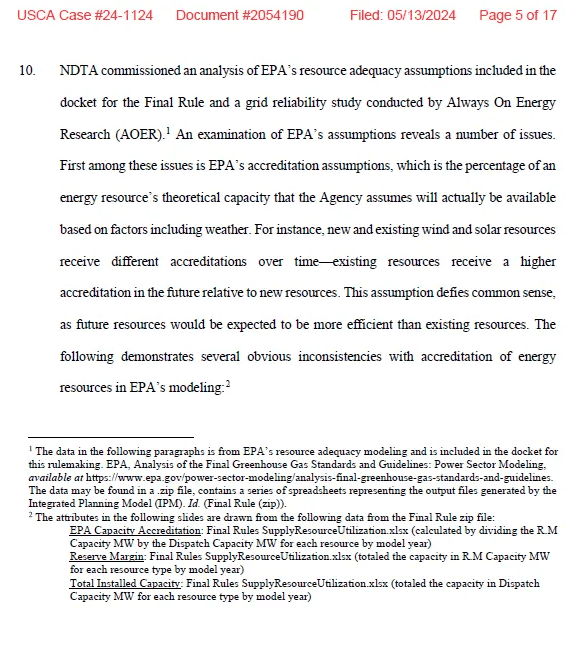
In November 2023, we launched our first Substack article entitled Enjoy the Blackouts, Jack. The article detailed our analysis showing how the Biden administration’s proposed greenhouse gas (GHG) regulations on existing coal and new natural gas plants would cause thousands of hours of rolling blackouts and cost hundreds of billions more than the agency projected.
What made our analysis unique was that we were the only group in the country to model the reliability of the regulations using the Biden EPA’s own capacity assumptions from the Integrated Planning Model (IPM).
While other, better resourced, firms debated the definition of “adequately demonstrated” for carbon capture and so-called green hydrogen, we wanted to make a broader and more important point: These regulations presented a clear and present danger to the American public they were ostensibly supposed to protect.
Over the ensuing three years, our subsequent modeling work on these regulations would be referenced in the lawsuit filed on behalf of West Virginia and a number of other states, potentially setting up a showdown for the Biden rules at the United States Supreme Court.
Monday marked the latest twist in this saga, as the Trump administration’s EPA announced it had finalized a narrow repeal of the Biden administration’s regulations requiring that existing coal plants seeking to operate beyond 2039 and new baseload natural gas plants operating above 40 percent capacity factors meet CO₂ limits based on 90 percent carbon capture and sequestration by 2032.
However, the Trump EPA made another move that was somewhat unexpected.
It didn’t merely continue to argue that EPA has no authority to regulate greenhouse gas emissions from U.S. power plants because these emissions are too small to meaningfully affect future global temperatures—thus removing the ability of future administrations to issue new GHG rules on power plants. EPA actually released a supplemental proposal that advances several additional legal arguments to repeal all federal power-plant greenhouse-gas standards under Clean Air Act §111, including the 2015 standards that limited carbon dioxide emissions from new coal plants.
We believe the Trump EPA wanted to repeal the most onerous provisions of Biden regulations as quickly as possible to deliver regulatory certainty to coal operators and companies looking to build new natural gas plants, while giving itself more legal avenues to argue that EPA lacks the authority to regulate GHGs from the power sector.
Without this second supplemental rulemaking, future liberal administrations will almost certainly attempt to regulate coal and gas power plants off the grid using whatever rationale they can muster. Even if these arguments rest on weak or unsupported claims that a given emissions-reducing technology is “adequately demonstrated,” the real tool in their toolbox is stoking regulatory fear, uncertainty, and doubt to deter investments in future coal and natural gas power plants.
EPA announced the supplemental proposal will undergo a 45-day comment period. Participating in this comment period means we are playing for all the marbles. To continue this important work of ensuring an affordable, reliable American electric grid, we are asking for your help in financially supporting Always On Energy Research.
We hope to raise $250,000 for our efforts. As a non-profit, all contributions are tax-deductible. You can contribute by clicking here, or reach out to us at [email protected] to speak with us directly.
Thank you for your ongoing readership and support. Now, the deeper dive into what’s at stake.
The Biden Rules
For long regulatory sagas, it helps to have the cliff notes available to jog one’s memory. Readers seeking the longer version can read our articles on the subject here, here, here, and here, or our formal 35-page comments and 52-page report. We suspect most readers will be happy with the short version.
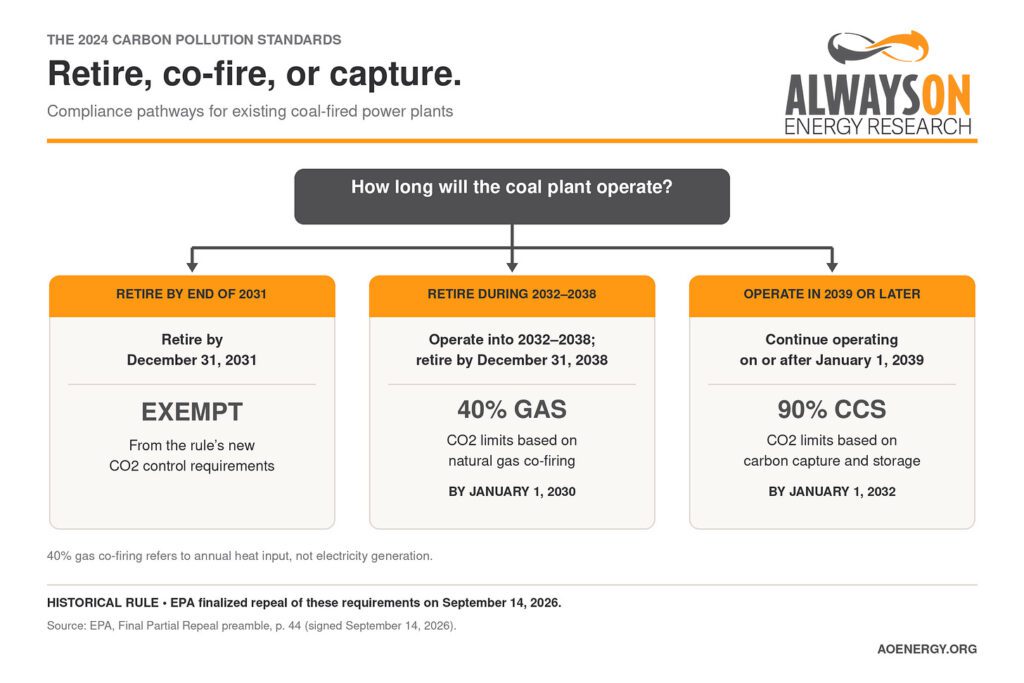
The Biden EPA enacted regulations requiring existing coal and new baseload natural gas plants to reduce their greenhouse gas emissions to meet CO₂ limits based on 90 percent carbon capture and sequestration by 2032.
For reference, no coal plant has ever achieved this level of carbon capture over a full year, including the facilities the Biden administration cited to justify the claim the technology was adequately demonstrated. This means the rules were effectively a death sentence for the nation’s remaining coal plants. The three “compliance options” for coal are outlined in the diagram below.
The Biden EPA’s carbon-capture requirement for new natural gas plants operating above a 40 percent capacity factor was similarly onerous. Carbon capture for gas is theoretically easier than coal, but it was still unproven and would’ve been costly for the industry.
While the technical justifications for the rules were bad, the Biden EPA’s astonishingly poor modeling was worse.
As we demonstrated in our analysis on behalf of the Prime Mover Institute, the Biden EPA concealed the true cost of its regulations in unrealistic baseline assumptions. This helped them claim massive benefits for the rule, even though compliance meant hundreds of billions more in investments than they modeled.
EPA also neglected to model the reliability of its rules; it simply assumed they were reliable. This was a major error, especially because the agency assigned entirely unrealistic 80-100 percent capacity values to solar in Southwest Power Pool (SPP) throughout the EPA model years. This left the region entirely dependent on wind and solar to meet demand and its reserve margin, as the graph below of accredited capacity shows.
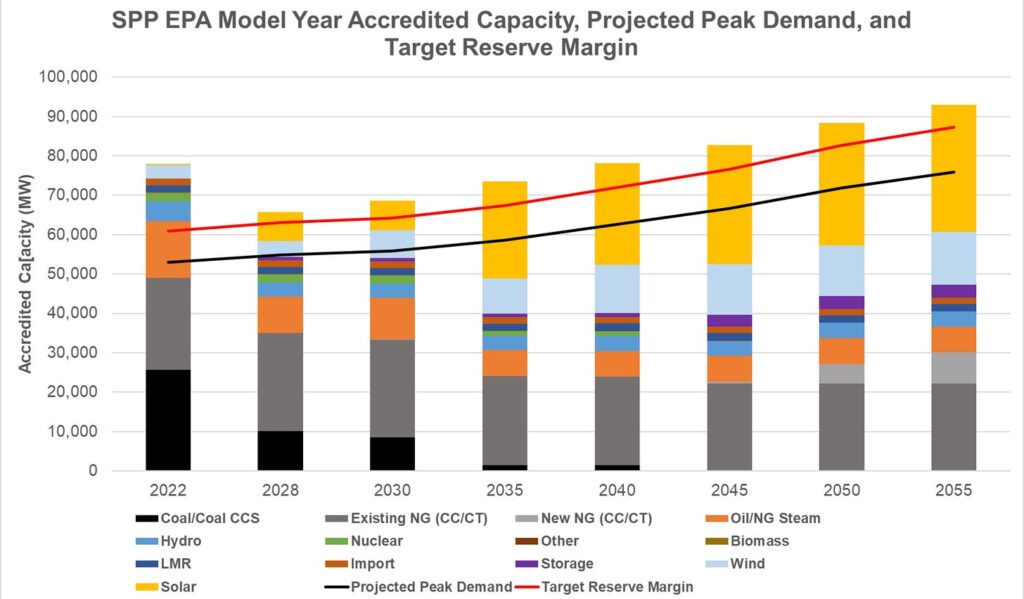
Our modeling showed this error could’ve resulted in 13 unique capacity shortfall events in the region based on the assumed capacity in EPA’s SPP grid in 2040.
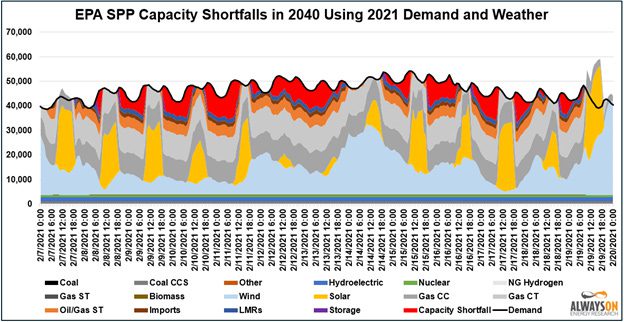
For context, solar currently holds a 63 percent capacity value in SPP because of how small the solar fleet is in the region, but will eventually drop to below 20 percent as the RTO adds more in the future. We touched on this feature of diminishing capacity values for wind and solar in our article, More is Less with Wind and Solar.
The breakneck speed and clear reliability threat presented by the Biden EPA’s rules prompted four of the largest power grid operators in America, PJM, MISO, SPP, and ERCOT, which serve all or part of 30 states and 155 million people, to take the unprecedented step of warning the agency that its proposed regulations could undermine the reliability of the U.S. electric system.
Despite their concerns, these RTOs have not applauded the repeal of these rules at the time of this writing,
In summary, the Biden EPA enacted rules that would fundamentally transform the entire U.S. electric grid while conducting resource adequacy and reliability analyses that are less rigorous than a state-level Integrated Resource Plan (IRP) proceeding.
The Trump Repeal
In the agency’s fact sheet, EPA said it is repealing most Biden-era requirements because they relied on technology that is not available at the scale and pace required to produce the emissions reductions touted by the prior administration.
In essence, the repeal applies to all Biden greenhouse gas regulations on existing coal plants and repeals the carbon capture requirements on new baseload natural gas.
EPA’s Regulatory Impact Analysis, a long document designed to show the costs and benefits of the rules, shows that this repeal will save Americans up to $310 billion, a substantial increase over the $19 billion the agency initially argued in 2025.
The additional benefits in the EPA analysis, which we have not had time to independently vet, stem from three distinct categories: avoided power plant compliance costs, fewer subsidies for intermittent generators and carbon capture and sequestration, and economy-wide gains as consumers have more money in their pockets.
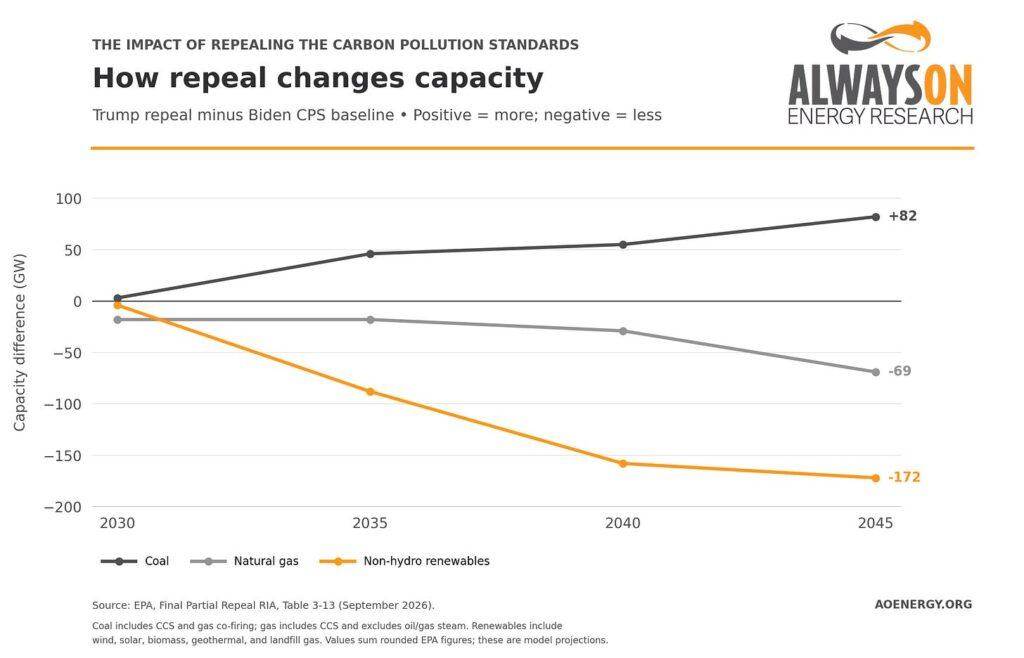
EPA’s updated analysis incorporates higher projected electricity demand from data centers and tax changes under the One Big Beautiful Bill Act (OBBBA). Lower power sector compliance costs in the repeal stem from retaining more coal plants and increasing utilization rates at natural gas power plants to meet rising data-center demand compared to the Biden regulations. You can see the changes in capacity in the graph below.
The Prize
EPA argues that the supplemental proposal advances four independent legal theories with the logic that if any one of these theories is finalized and upheld, the rule can stand on that basis alone. They include:
- Local and regional exposure. EPA states that Clean Air Act §111(b) only reaches air pollutants that cause local or regional exposure. Greenhouse gases only “endanger” on a global scale, and are therefore outside EPA’s jurisdiction.
- 2015 Findings were independently unlawful. Even if climate could count, EPA says it never validly listed a new “fossil fuel-fired EGUs” category when it merged steam units and turbines solely to regulate GHGs.
- No clear congressional authorization. EPA argues that using §111 to set national climate policy is a question of vast economic and political significance. West Virginia and UARG require clear congressional authorization, and the generic listing language in §111(b)(1)(A) is not that clear statement.
- Futility / de minimis. EPA models wiping out all U.S. fossil power-plant GHG emissions and says the effect on global temperature, sea-level rise, and similar metrics is only de minimis. If regulation cannot materially affect the alleged danger, the source category does not “contribute significantly,” and §111 is not a climate statute.
Our Role
Beyond these legal theories, the supplemental proposal gives us a generational opportunity to reform how EPA evaluates its power-grid regulations because the agency is specifically requesting comments on how it can improve the accuracy and transparency of its power-sector modeling in future rulemakings.
Our plan to demonstrate the value of the repeal goes as follows.
- Calculate the Reliability and Cost of a New Regulatory Scenario: The finalized EPA repeal of Biden’s regulations removes the immediate threat to the coal fleet and lifts restrictions on new natural gas, but it does not slay the uncertainty dragon in the long run. We will model the cost of a future regulatory scenario using more plausible emissions-reduction technology, such as lower carbon capture thresholds, to determine its impacts on cost and reliability.
- Research and Recommend Open Source Electricity Modeling Programs to EPA: This process will allow us to recommend more transparent modeling programs for the EPA. The economic impact analysis (EIA) for the supplemental proposal notes:
IPM was developed almost three decades ago to analyze the power sector as it existed at the time. Since IPM was developed, the electricity sector has changed in fundamental ways. Stakeholders consistently raise that the power sector is dynamic and increasingly complex, and that the EPA should adjust our analytical approach to rely on models and/or tools that are transparent and adaptable. Alternative models exist that are potentially better suited to the analytical questions that will be most important to future regulatory analyses.
EPA is currently exploring several open-source power sector modeling alternatives and plans to replace the Agency’s current power sector model (i.e., IPM) for power sector regulatory analysis with one or a combination of these alternative models in the future.
Always On will research several of the open-source programs to determine if they are suitable for recommendation.
- Recommend Reliability Modeling Methods: EPA should be required to conduct hourly reliability analyses of the modeled grids produced by the IPM. Always On’s comments will focus on creating a step-by-step guide that the agency can use to evaluate grid reliability.
- Recommend a Social Cost of Blackouts: By far the largest modeled benefit in the Biden greenhouse gas rules was the social cost of carbon estimates, which constituted 69 percent of the total purported benefits of the rules as a result of avoided climate change costs. However, the agency not only missed the full cost of compliance by severely underbidding the grid, but it also did not model the costs of the blackouts stemming from its regulations. We will show EPA how to estimate the costs of potential power outages from its rulemaking using methodology we developed in our innovative May report, Introducing the Social Cost of Blackouts: A Pragmatic Guide for Policymakers.
Conclusion
We are still wading through the technical details of the final rules and the supplemental proposal. What is obvious is that there is a significant opportunity to remove the threat of regulatory uncertainty in the power sector for decades to come, and to meaningfully reform the modeling used by EPA in the future.
While we are not legal scholars, we feel it is important to weigh in on the modeling issue, and we would appreciate any support you can give as we work toward our $250,000 goal.
As a non-profit, all contributions are tax-deductible. You can contribute by clicking here, or reach out to us at [email protected] to speak with us directly
We are blessed to have an insightful audience with many readers in the industry. If you have other suggestions for us to examine in the comment period, we would love to hear them via email or in the comments.
Thanks for reading.
This piece was originally published by Isaac Orr and Mitch Rolling on September 19 at the Energy Bad Boys on Substack.