Heading into the summer means that reliability assessments are dropping! And on that note, last week, the New York Independent System Operator (NYISO) released its Summer 2026 Capacity Assessment.
It’s 15 slides long, and every one of them should alarm Albany, which is currently struggling over what to do with its Climate Leadership and Community Protection Act (CLCPA).
Friend of the Court, but not Friend to New Yorkers
Last week, 17 Democratic state legislators and Assembly members filed a “friend of the court” amicus brief in Citizen Action of New York v. DEC, the lawsuit, supported by the Sierra Club, which tries to force Governor Kathy Hochul’s administration to implement the CLCPA on schedule. The 2019 CLCPA requires the state to cut greenhouse gas emissions by 40% by 2030, and 70% renewables by 2030, which it will fall woefully short of.
The brief demands that the Department of Environmental Conservation (DEC) issue cap-and-invest regulations on schedule, damn the consequences.
The argument?
Legislators knew all along that it would hurt New Yorkers.
The Wall Street Journal editorial board already pulled out some gems from the brief. The Legislature “knowingly enacted a statute that would require large-scale economic transformation, including substantial and uncertain costs.” The law, their lawyers argue, “directly acknowledges that the transition to a clean energy economy may impose costs and affect certain sectors more than others,” including job displacement in oil and natural gas industries. They cite floor statements from 2019 where a Democratic senator acknowledged the bill would “ask people to make sacrifices.”
A Republican senator, Minority Leader Ortt, warned at the time that the CLCPA would result in “a loss of jobs,” “increased energy rates,” and “further hampering of New York’s economy.” The brief argues that those arguments were “rejected or otherwise addressed.”
Then and now, the Democrats’ response to objections has been that climate change makes the pain worth it. One Democratic senator proclaimed in 2019 that even if the mandates bring “hard times,” “if we haven’t saved our planet, the rest is moot.”
These legislators are arguing, in a legal filing, that they understood the consequences to New Yorkers and voted yes anyway. Maybe they should be paying attention to NYISO.
What NYISO is actually telling New York
The trend
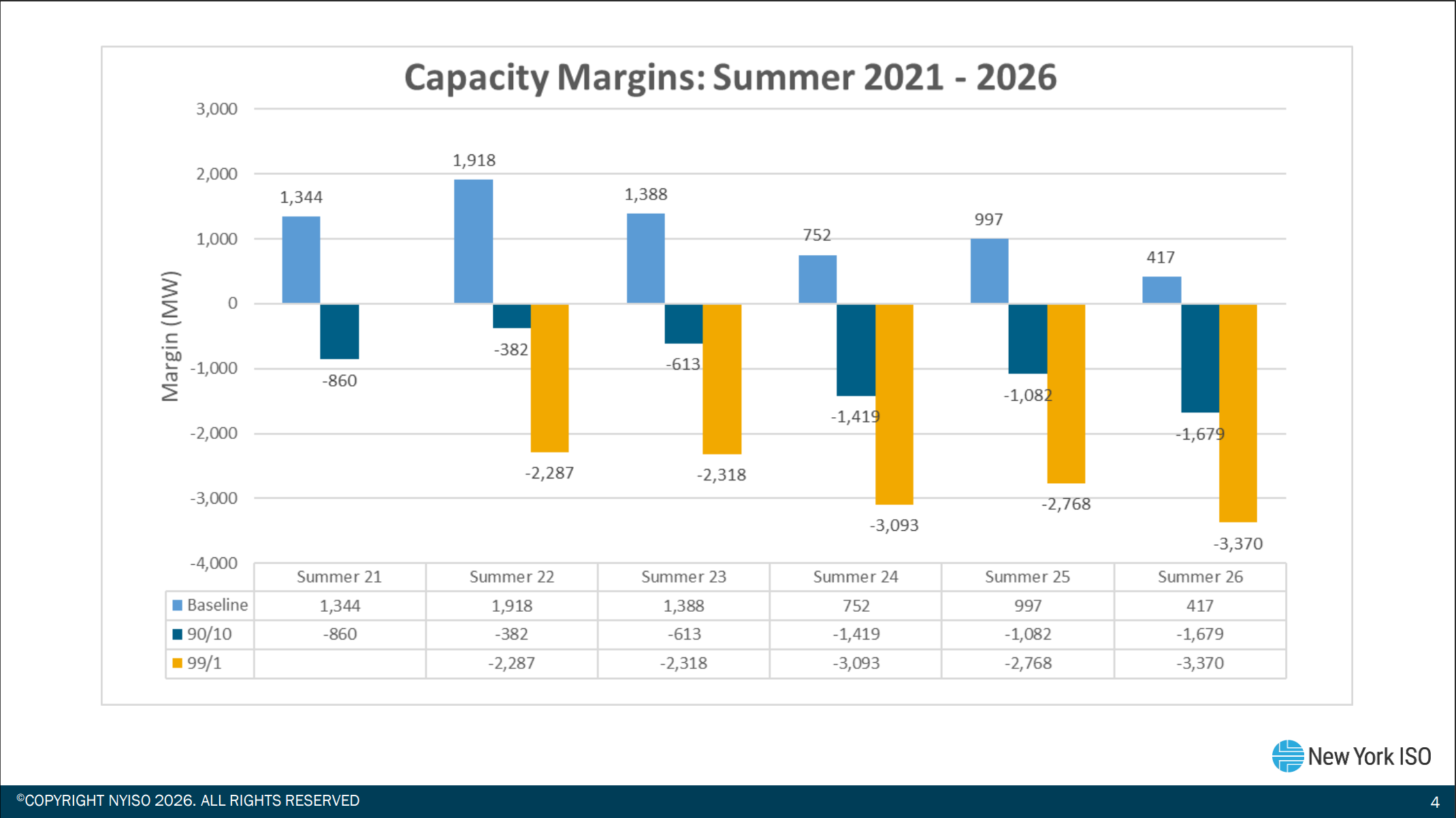
Slide 4 of NYISO’s Summer 2026 Capacity Assessment shows NYISO’s capacity margin — the gap between available resources and expected peak demand — under three scenarios: baseline conditions (light blue), a 90th-percentile heat event (dark blue), and a 99th-percentile extreme (orange).
Under baseline conditions, the expected margin peaked at 1,918 MW in Summer 2022 and has fallen to 417 MW this summer. That’s a 78 percent decline in four years.
Under a 90/10 heat scenario, modeled at 95°F for three or more days, the margin has been negative every single year since 2021, and has reached a 1,679 MW shortfall this summer. Under a 99/1 extreme, modeled at an average 98°F sustained, the deficit has widened to -3,370 MW, the worst in the six-year series.
The math
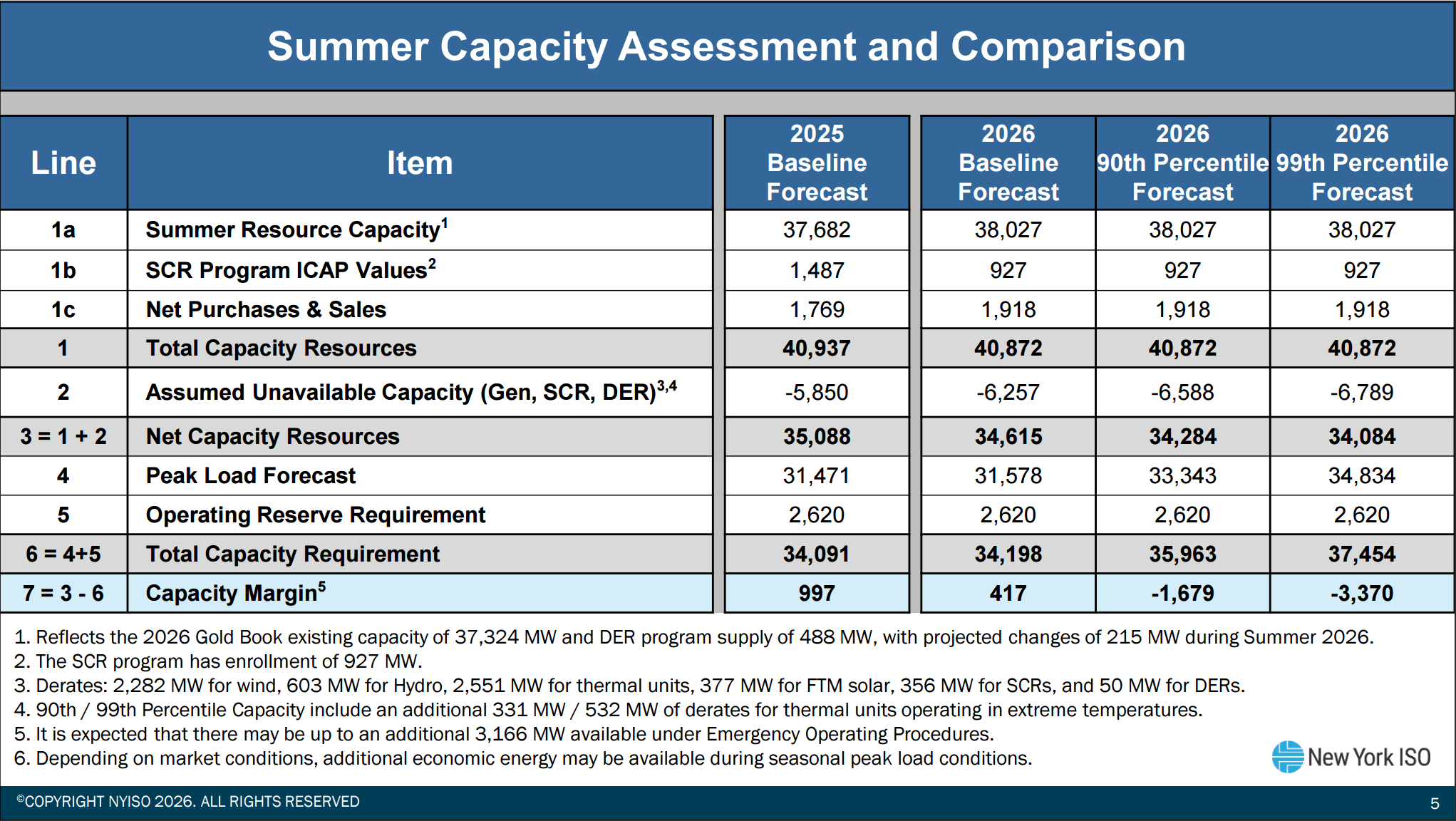
This table shows how NYISO gets from installed capacity to that 417 MW margin. Start with 38,027 MW of summer resource capacity and 927 MW of demand response enrollment. Add 1,918 MW of net imports. That gives you 40,872 MW of total capacity resources, down 65 MW from last summer, despite 225 MW of new nameplate additions (more on that momentarily).
Then the derates start. NYISO assumes 6,257 MW of capacity will be unavailable under baseline conditions. Turns out that NYISO derates 2,282 MW for wind, 603 MW for hydro, 2,551 MW for thermal units with performance issues, 377 MW for front-of-meter solar, 356 MW for demand response, and 50 MW for distributed energy resources.
After derates, net capacity resources are 34,615 MW. Peak demand is forecast at 31,578 MW. NYISO must hold 2,620 MW in reserve. That leaves 417 MW.
Note that the demand response program (SCR) dropped from 1,487 MW last summer to 927 MW this summer, a loss of 560 MW of curtailable load. That’s more than the entire capacity margin. The drop is partly a correction, since NYISO’s 2024 capacity accreditation reforms reduced the credit given to short-duration demand response resources, which were likely being overvalued. But the participants who left in response took real curtailable load with them, and NYISO’s margin calculation already reflects the loss.
Second, notice that peak demand rose from 31,471 MW to 31,578 MW while net capacity resources fell from 35,088 MW to 34,615 MW. The gap is closing from both sides.
And 417 MW of margin on 31,578 MW of peak demand is just 1.3%. That’s getting awfully close to zero.
To the surprise of no one, there’s another unfortunate number to report: New York has added zero dispatchable resources since last summer. Slide 11 shows total nameplate additions of 225 MW, comprised of 15 MW of battery storage, 90 MW of solar, and 120 MW of wind.
NYISO’s VP of operations, Aaron Markham, put it plainly:
“The assessment reflects “declining reliability margins, performance issues with aging generators, and an absence of new dispatchable resources.”
New York City is already underwater
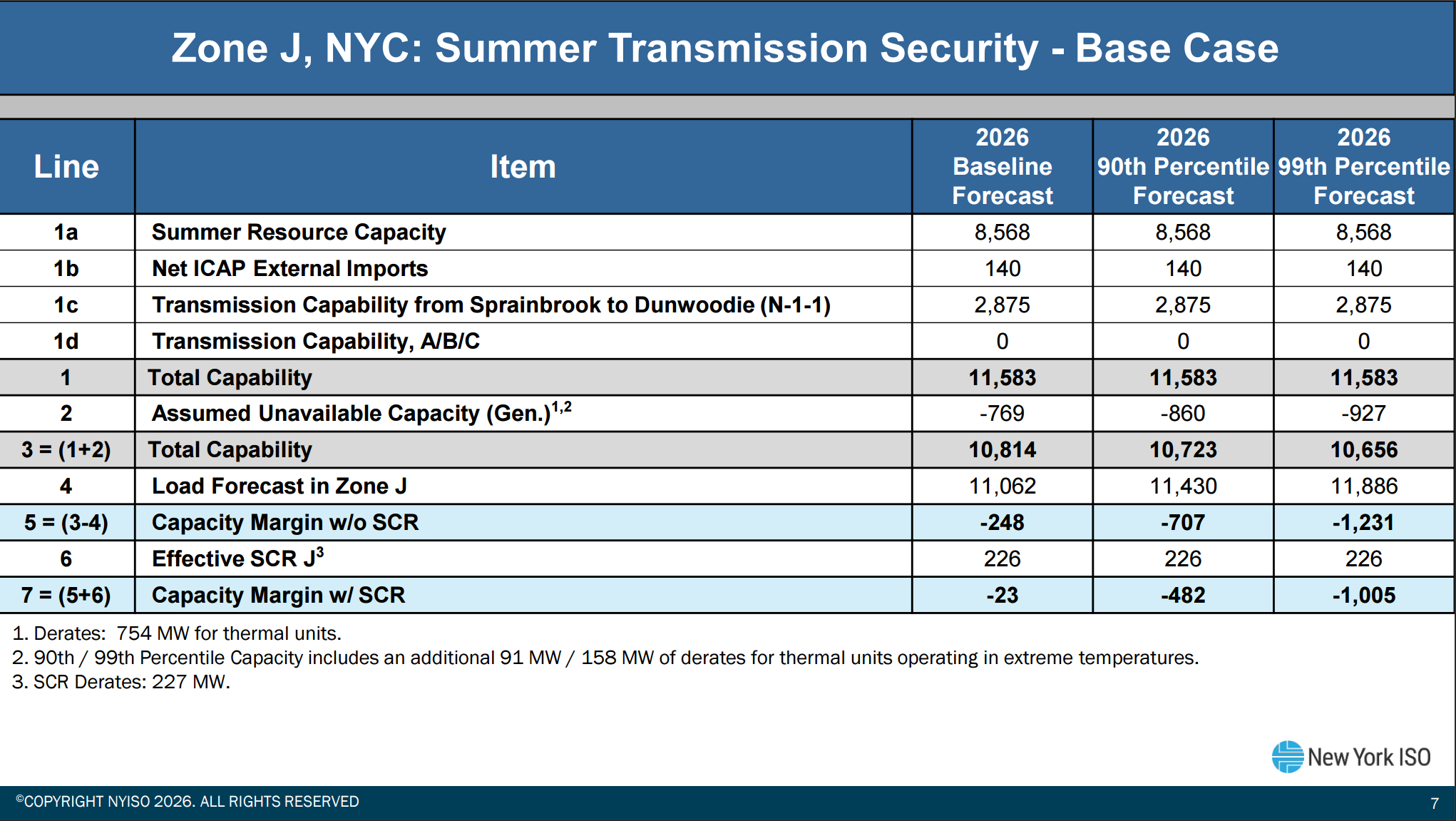
The statewide numbers are alarming, but New York City is worse. Zone J, which covers the five boroughs and the load pocket that Indian Point used to serve, is already in deficit under baseline summer conditions, before any heat wave.
NYC has 8,568 MW of summer resource capacity, plus 140 MW of imports and 2,875 MW of transmission capability from Sprainbrook to Dunwoodie. After derates, net capability is 10,814 MW. The baseline load forecast for Zone J is 11,062 MW. Without demand response, that’s a capacity shortfall of -248 MW on a normal summer day. With 226 MW of demand response, the margin is still not quite zero, at -23 MW.
Under a 90th-percentile heat event, the deficit grows to -482 MW with demand response. Under the 99th-percentile scenario, it’s -1,005 MW. This is a city of 8.3 million people that closed a 2,069 MW nuclear plant five years ago on the orders of a governor who wanted to prove New York could run on renewables and imports. Can it, really?
“Breathing room” would sure be nice right about now
As I wrote in March, Governor Hochul has asked the legislature for “breathing room” on the CLCPA’s timelines. She has reason to, since the New York State Energy Research and Development Authority estimated that meeting the law’s 2030 emissions target would cost upstate New York households more than $4,000 per year and add $2.23 per gallon to gasoline prices.
New York already posts the eighth-highest residential electricity price in the country at 26.95 cents per kWh. And despite the CLCPA’s mandate of 70 percent renewable electricity by 2030, renewables, including conventional hydroelectric, made up just 23.2 percent of New York’s generation in July 2025.
Hochul’s party won’t let her off the hook. More than two-thirds of the state legislature’s Democratic caucus sent her a letter in March saying they “categorically oppose any effort to roll back New York’s nation-leading climate law.” Senate Finance Committee chair Liz Krueger accused the governor of “trying to convince the rest of us that we have no choice but to turn our backs on what we know are the right answers and shift into a more Trump-like set of policies.” Neither the Senate nor the Assembly included CLCPA rollbacks in their budget resolutions, and a showdown is brewing.
To the Legislature, the “right answer” must be pursued at all costs, which they knew about when the law was passed, and didn’t care about, then or now.
Conclusion
The CLCPA requires 100 percent zero-emission electricity by 2040. Hochul has refused to consider reopening Indian Point despite Energy Secretary Chris Wright’s push to do so. The state’s plan to close the gap relies on the Champlain Hudson Power Express — a 1,250 MW transmission line importing Canadian hydropower — and the 816 MW Empire Wind offshore project. CHPE is physically near completion, but thanks to missed deadlines from FERC and the NYISO capacity market, it probably won’t be available to transmit to New York City this summer. There has been no new dispatchable additions since last summer.
New York’s CO2 reductions will have no measurable effect on global temperatures, but they will have a measurable effect on New Yorkers’ electricity bills and on whether the grid can survive a July heat wave. Albany Democrats consider the tradeoffs worth it.
This piece was originally published at Montalbano Mondays on May 4, 2026, on Substack.