
“The interesting thing about the Green New Deal, is it wasn’t originally a climate thing at all. Do you guys think of it as a climate thing? Because we really think of it as a how-do-you-change-the-entire-economy thing.” – Saikat Chakrabarti, former chief of staff to Representative Alexandria Ocasio-Cortez.
It has been over seven years since then-Freshman Congresswoman Alexandria Ocasio-Cortez introduced the Green New Deal in Congress, and nearly 20 years since Thomas Friedman coined the term in a New York Times article in 2007. However, recent developments with respect to surging electricity demand have all but eliminated the prospect of a primarily renewable, carbon-free future.
Many observers understood that the Green New Deal was never a realistic energy future. Wind and solar were incapable of replacing existing generators and meeting existing demand during a period of stagnant load growth. Despite the best efforts of blue-state policies mandating wind and solar construction and prematurely retiring coal plants, the only result has been increasingly dire warnings about grid reliability from the North American Electric Reliability Corporation (NERC).
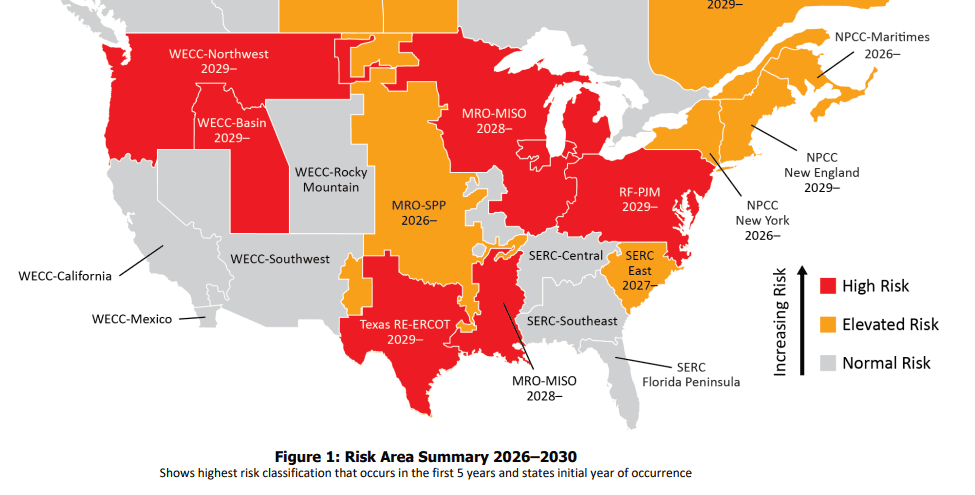
Now, with the rise of data centers and projected demand increases, a very clear picture is emerging of where the future of energy truly lies —and it’s where it always has been: with dispatchable, fuel-based generators.
A fascinating new report from the Global Energy Monitor (GEM) contains a treasure trove of data, and it clearly shows that the future of U.S. power generation belongs to natural gas, and it’s going to be a “change-the-entire-economy thing.” We’re officially in the era of the Gray New Deal.
The Tables Have Turned
Four years ago, the prevailing wisdom was that the world would transition away from coal and natural gas to a system primarily powered by wind, solar, battery storage, and perhaps some natural gas combustion turbine units that would run infrequently but deliver important, reliable capacity.
For example, in March 2022, the U.S. Energy Information Administration’s Annual Energy Outlook (AEO2022) assumed new natural gas would essentially serve to replace retiring coal capacity through 2030, and then increase to slightly less than 1,000 gigawatts (GW) of installed capacity by 2050, which you can see in the graph below.
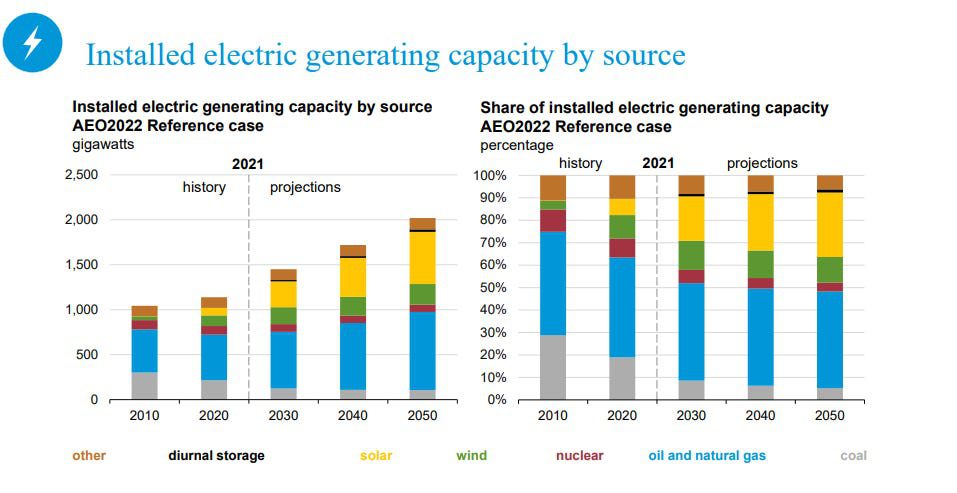
Meanwhile, wind and solar would grow enormously, reaching nearly 40 percent of all generation capacity in 2050, up from 20 percent in 2020.
The share of power generated from wind, solar, geothermal, and hydroelectric power in the AEO2022 was expected to rise from 21 percent in 2021 to 44 percent by 2050. Natural gas was expected to have a modest decline in the share of the electricity pie, falling from 37 percent in 2021 to 34 percent of total generation in 2050.
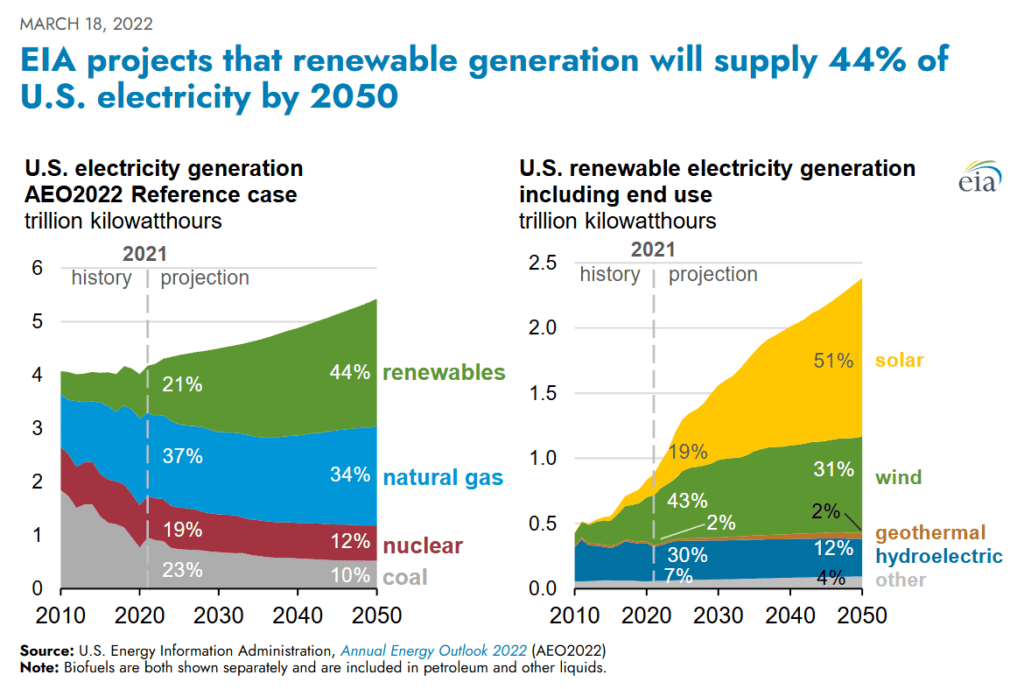
The GEM data suggest we can safely discard the 2022 forecasts.
The Gigantic Gas Buildout
According to GEM’s analysis, the U.S. plans to build 181 gigawatts (GW) of new natural gas capacity to meet data center demand alone, with an additional 189 GW to comply with the proposed natural gas capacity in utility integrated resource plans (IRPs).
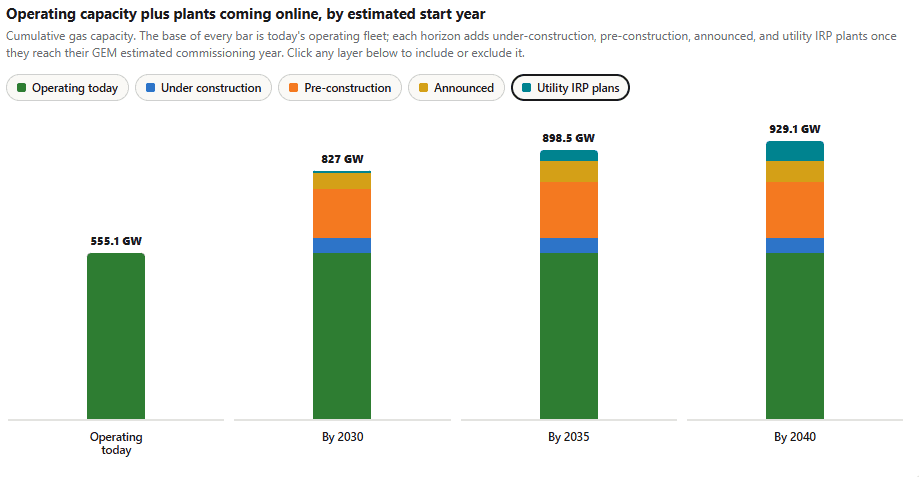
This amounts to a total new gas buildout of approximately 370 GW by 2040. For context, GEM data show that the U.S. has 555.1 GW of existing natural gas capacity, meaning overall gas installations are projected to increase by 55 percent by 2040, as shown in the graph below.
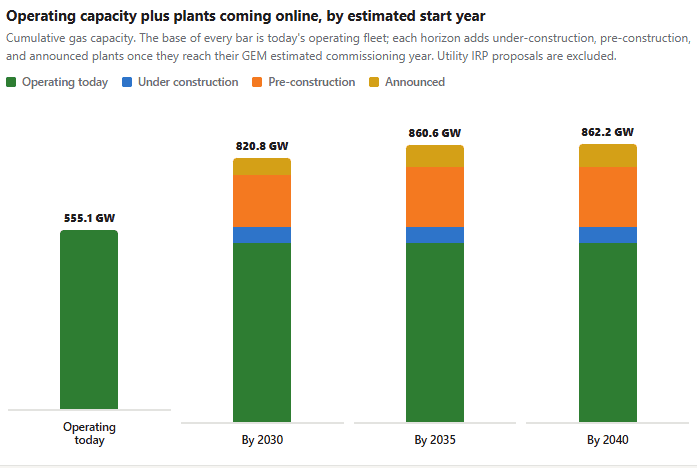
GEM data also show that utility integrated resource plans identify an additional 81 GW of potential natural-gas capacity that did not appear in their named projects development pipeline. If we include these less-developed IRP plans, it brings the potential new gas capacity to approximately 451 GW, an increase of 81 percent over the existing operating fleet.
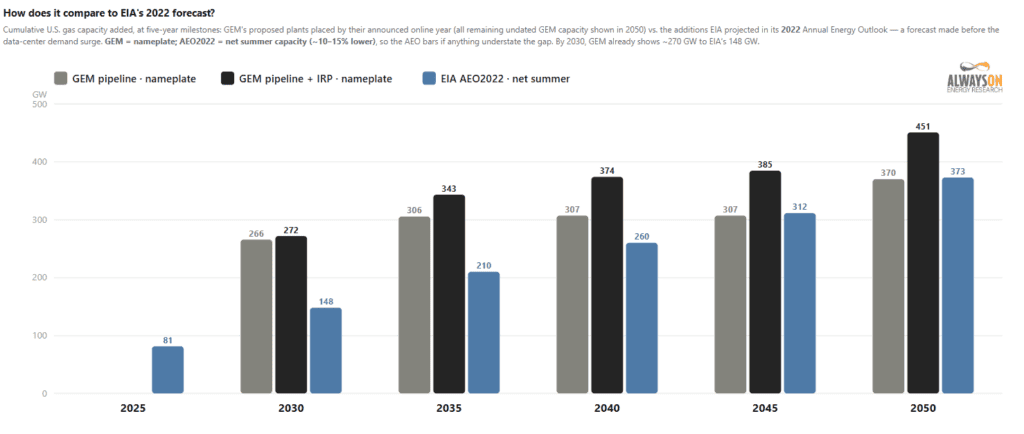
This means GEM’s potential gas buildout would trounce what EIA envisioned just four years ago. At every five-year milestone beginning in 2030, GEM’s project pipeline plus additional IRP capacity exceeds the cumulative gas additions projected in EIA’s AEO2022, although excluding the IRP additions results in the AEO2022 having higher gas capacity in 2045 and 2050.
Of course, all of this data should be taken with a grain of salt.
Some of these new gas GWs may never materialize, and some may be double-counted, as data center developers request gas as part of utility IRPs and then make their own plans to build the power plants themselves. Additionally, such a buildout would almost certainly require a massive increase in natural gas pipeline infrastructure, which has historically been met with heavy resistance from climate and environmental advocates.
However, the data doesn’t have to be perfect to be incredibly interesting.
The Buildout Balloons
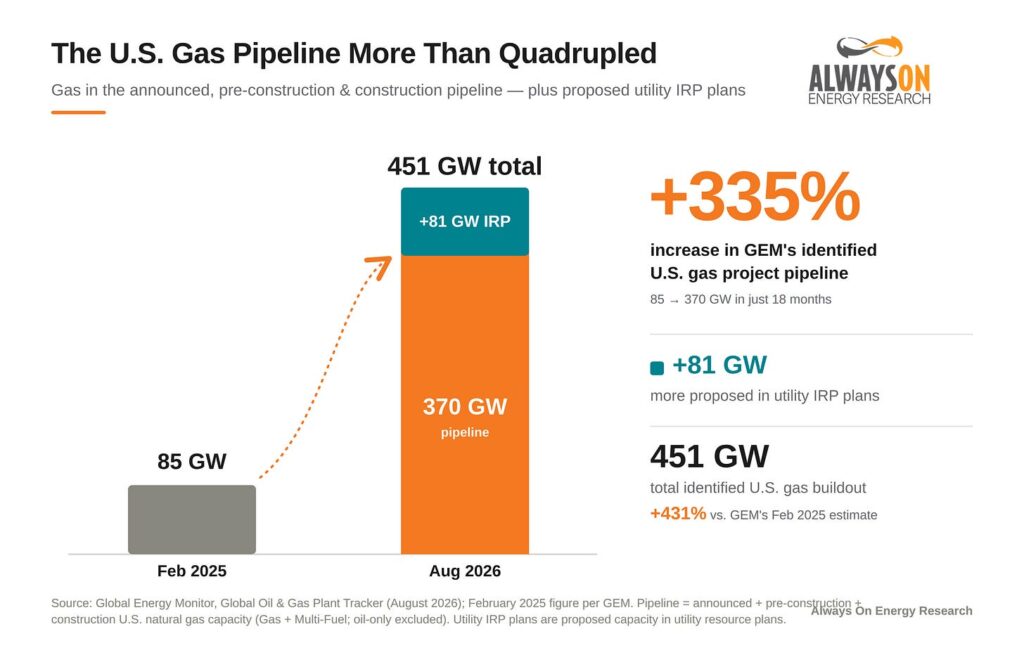
The scale at which natural gas projects are being proposed is absolutely stunning, or as our friend Robert Bryce would say—Crazytown bananas. For example, in February 2025, GEM reported an estimated 85 GW of U.S. natural gas projects in the announced, pre-construction, and construction phases. This means that in just 18 months, GEM’s identified U.S. pipeline increased by about 293 GW, or roughly 335 percent.
Contributing to this remarkable increase in projected gas capacity is the arrival of massive natural gas megaprojects. The map below shows the ten largest projects in the GEM database, which account for a total of 45.8GW of capacity. The “smallest” of the ten proposed projects is a 2.7 GW facility located in Utah, and the two largest are the Gigawatt Ranch, a 6,700 MW facility located in Texas, and the Portsmouth plant, a 9.2 GW plant in Ohio.

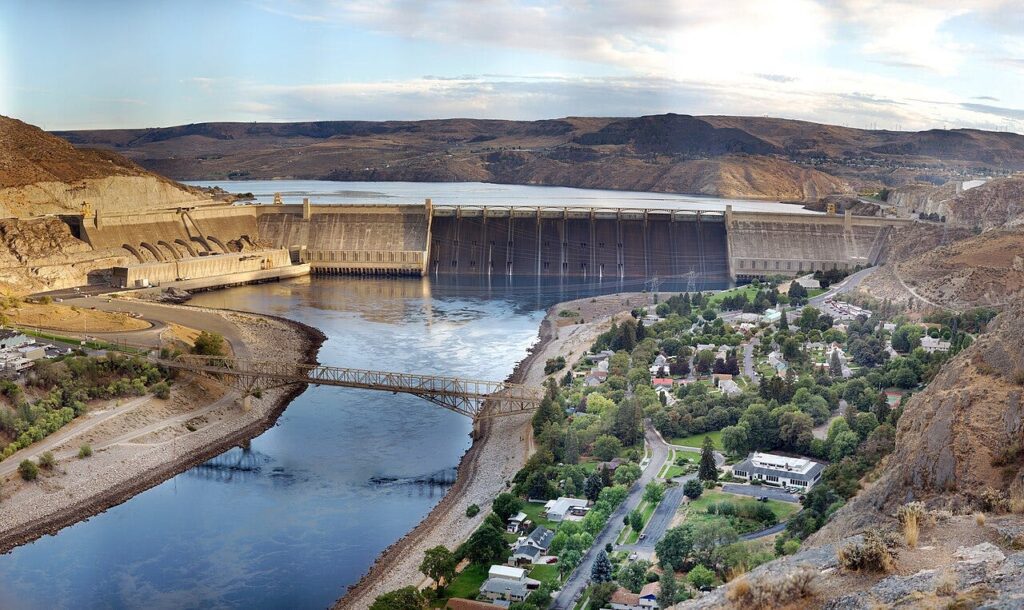
For context, the 9.2 GW Portsmouth plant would become the largest power plant in America, exceeding the 6.8 GW Grand Coulee Dam in Washington State.
This was a bittersweet announcement for Isaac, because he has a special fondness for Grand Coulee because Joe Rantz, the gold medal rower in the 1936 Olympics in Berlin from the book The Boys in the Boat, helped build the dam to earn enough money to stay in school. Alas, records were made to be broken.
Gas Generation vs. Wind and Solar Projections
We compared the GEM full natural gas buildout to the 2026 EIA Annual Electric Outlook (AEO) to see how the new natural gas projections compare with projections for wind and solar through 2040. It’s important to note that while the full natural gas buildout in GEM’s analysis may not materialize, the EIA AEO2026 is also highly speculative because it does not account for the potential repeal of regulations and policies that are favorable toward wind and solar.
So, like always, while it’s interesting to compare the recent trends, these projections should be taken with a grain of salt.
Capacity
According to the AEO2026, installed wind and solar capacity would increase by 239 GW and 253 GW, respectively, for a total of 492 GW. Natural gas would increase by either 370 GW or 451 GW if IRP plants are included.
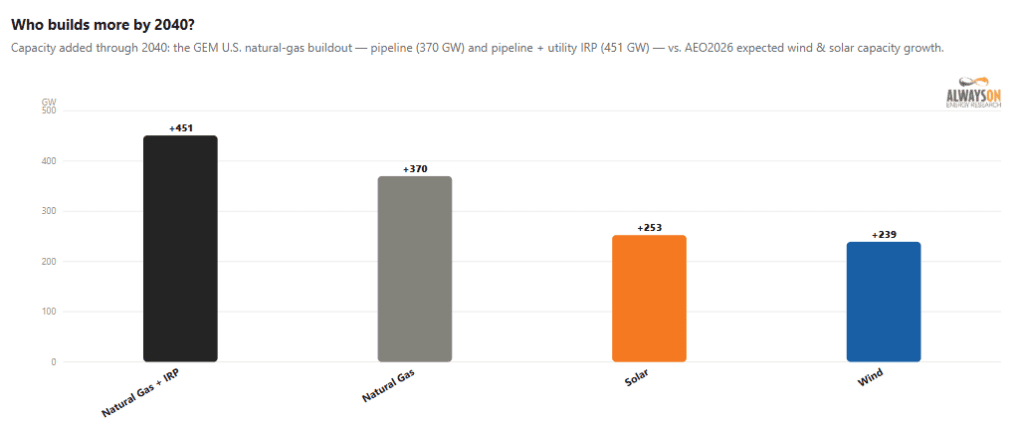
It’s important to remember that these are installed nameplate capacity figures, not reliable accredited capacity figures. As our readers likely already know from previous posts on capacity accreditation and capacity values, the wind and solar capacity shown above will contribute very little reliable capacity that grid planners can depend on during peak demand hours.
When you take into account typical capacity values for each resource, measuring natural gas 85 percent, wind at 20 percent, and solar at 10 percent—which is extremely generous for both wind and solar by 2040—natural gas dwarfs wind and solar numbers at 314 to 383 GW for natural gas compared to just 25 GW for solar and 48 GW for wind.
Generation
The more interesting question is whether natural gas would produce more electricity than wind and solar, even though this comparison adds less new gas.
Using the generation estimates for wind and solar in the AEO2026, we found that the new wind and solar facilities would only outproduce natural gas if the gas fleet’s capacity factor was limited to 40 percent, which is the limit established under the Biden administration’s Clean Power Plan 2.0 for combined cycle plants operating without carbon capture and sequestration equipment by 2032.
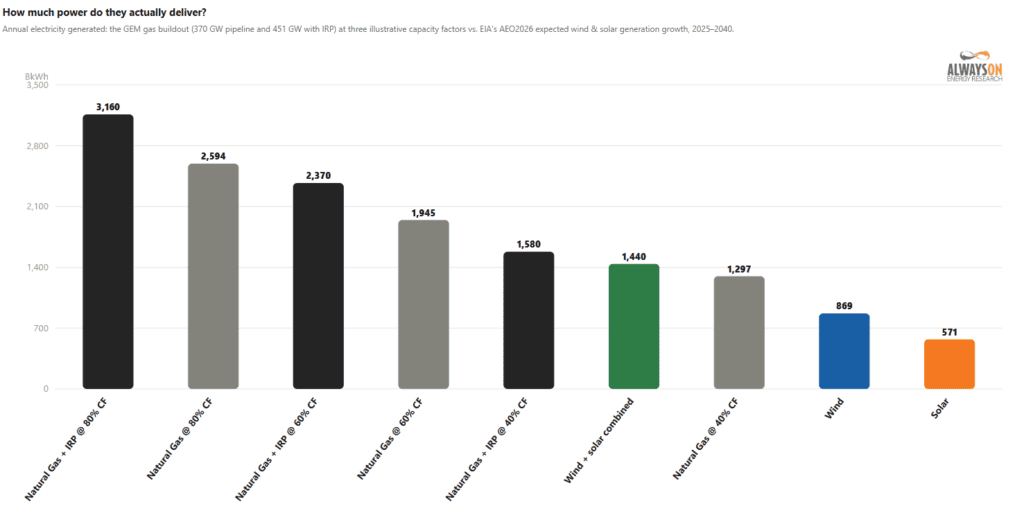
The constant and massive power demand from data centers makes it exceedingly unlikely that new gas plants will run at those artificially imposed 40 percent capacity factors, and carbon capture is no more realistic today than it was two years ago.
This strongly suggests that natural gas is the fuel of the future.
Conclusion
The future of American energy belongs to natural gas.
The surge in natural gas facilities needed to power significant projected load growth highlights a clear energy reality we need to face before we keep repeating the same mistakes of the last few decades.
No matter how “modern” their boosters may claim they are, wind and solar are still dependent on the weather. Modern society was built to overcome the obstacles of nature, and wind and solar simply do not accommodate these needs. There’s a reason society turned to fuel-based resources like coal, natural gas, nuclear, and hydro in the first place.
Even if many of the actors driving the surge in natural gas won’t fully admit it, America is slowly reawakening to the fact that when it needs always on, always available electricity, energy sources that can be dispatched at any time are the only resources that can do the job.
The Green New Deal is dead, long live the Gray New Deal.
A version of this piece was originally published by Isaac Orr and Mitch Rolling at Energy Bad Boys on Substack on September 5, 2026.