When we started in the energy industry over a decade ago, it was very common to hear the claim that “renewables are the cheapest energy sources,” based on Levelized Cost of Energy (LCOE) metrics. Many advocates added, “even without subsidies!”
These claims went largely uncontested for years, with journalists and the mainstream media seemingly eager to parrot common talking points from wind and solar advocates with little understanding of what LCOE is—or how it was being used inappropriately.
This lopsided representation of LCOE in the press fueled our curiosity on the subject, prompting us to experiment with ways to correct for the shortcomings of the metric as early as 2019. Our 2023 series, which dismantled the myth that wind and solar are the cheapest forms of energy, was cited by Doomberg in their piece Debunking the Levelized Cost of Energy.
Fast forward to today, and using LCOE to argue for the “low cost” of wind and solar has become one of the clearest indications that someone is either misinformed or is relying on an outdated understanding of power systems.
While the debate is not over, policymakers, regulators, and analysts increasingly recognize that the cost of generating electricity and the cost of reliably serving customers every hour of the year are not the same thing. As a result, many of the institutions that spent years promoting LCOE comparisons are now developing their own firming-cost and full-system-cost methodologies to address the shortcomings of their previous analyses.
LCOE: The Metric That Was Asked to Do Too Much
In truth, LCOE should never have garnered the media attention that it did.
The issue has never been the LCOE itself, which was not designed to compare the value of dispatchable, fuel-based resources with intermittent, weather-based resources. In fact, many of the organizations publishing LCOE studies at the time explicitly warned against doing so.
The problem was how the metric was (mis)used by wind and solar advocates to peddle the narrative that wind and solar were the cheapest forms of energy while ignoring the growing costs of maintaining reliability on a system increasingly dependent on intermittent resources.
What the LCOE Is (and Isn’t)
For those familiar with LCOE, you can likely skip this section. However, it helps to understand what the LCOE is, what it isn’t, how it originated, and how it has been used inappropriately for years by renewable advocates.
The Leveled Cost of Energy (LCOE) was designed to compare the cost of generating electricity from different resources over their useful lifespan. It emerged in the late 70s and early 80s, often called the “levelized busbar cost,” during a time when power plants on the grid consisted of fuel-based, dispatchable generators and were subject to cost-of-service regulation.
The LCOE ignored several things to simplify cost comparisons, such as cost variations throughout a plants lifespan, discount rates variations, performance variations, and most importantly, it didn’t assess system costs to incorporate new resources, such as transmission requirements. This is why it was called the “cost of the busbar,” because it was the cost of electricity generated before hitting the transmission and distribution systems.
It also ignored the value of the electricity produced, as well as the cost of maintaining reliability using intermittent resources—which is understandable for the time, but would have huge implications going forward.
This distinction is critical because electricity generated at different times does not have the same value. Dispatchable generators can generally produce electricity when it is most needed, while wind and solar generate electricity when weather conditions permit. LCOE ignores these differences entirely, treating every megawatt-hour as if it were equally valuable.
In other words, the LCOE was a cost-of-generating metric, as opposed to a cost-of-serving (or system-cost) metric.
As wind and solar facilities entered the market, however, LCOE was also applied to these weather-dependent resources. By 1995, the National Renewable Energy Laboratory (NREL) was already suggesting that “the LCOE could be used to compare the cost of energy generated by a renewable resource with that of a standard fossil-fueled generating unit.” This is where the trouble with LCOE begins.
The Misapplication of LCOE to Wind and Solar
During the early 2000s, several publications used the LCOE to argue that wind and solar were becoming low-cost alternatives to conventional power plants. A 2001 publication from the American Wind Energy Association (AWEA), for example, stated:
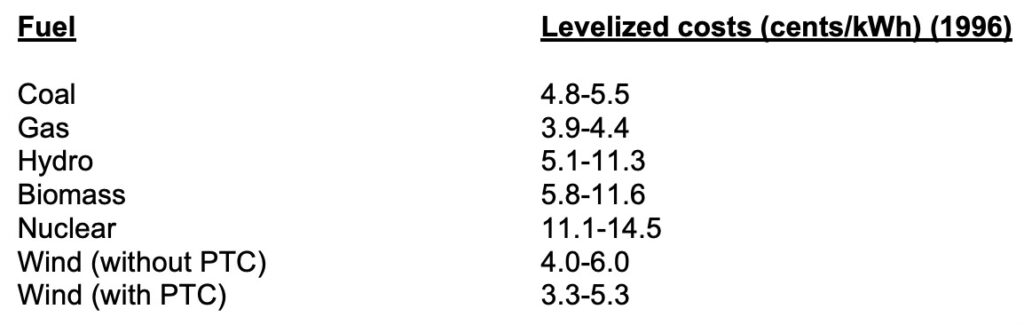
The cost of wind energy is declining steadily. Long-term forecasts of the early 1990s… that wind would ultimately become the least expensive electricity generation source are no longer pipe dreams. It is clear that wind’s costs are now in a competitive range with those of mainstream power technologies.
AWEA also provided a table showing levelized cost estimates at the time:
Around the same time, Lazard began publishing its annual LCOE report, which has become one of the most widely cited sources in debates over electricity resource costs, including in arguments for building new wind and solar resources.
The problem is that LCOE is wholly inadequate to compare the cost of intermittent resources like wind and solar with dispatchable resources like natural gas, coal, and nuclear. By 2011, economist Paul L. Joskow of the Sloan Foundation and MIT put this into writing, stating:
“Levelized cost comparisons are a misleading metric for comparing intermittent and dispatchable generating technologies because they fail to take into account differences in the production profiles of intermittent and dispatchable generating technologies and the associated large variations in the market value of the electricity they supply. Levelized cost comparisons overvalue intermittent generating technologies compared to dispatchable base load generating technologies.”
By 2014, the Energy Information Administration (EIA) was publishing LCOE reports in its Annual Energy Outlook (AEO) with the following warning:
“The LCOE values for dispatchable and nondispatchable technologies are listed separately in the tables, because caution should be used when comparing them to one another.”
Unfortunately, those warnings did not stop LCOE figures from being used to make direct comparisons between resources that provide very different reliability value to the grid.
Naturally, this meant that any serious effort to evaluate the cost of wind and solar needed to move beyond traditional LCOE and account for the full system costs associated with intermittent generation, including reliability, backup generation, transmission, overbuilding, and curtailment.
While Joskow’s paper and the EIA warning were steps in the right direction, LCOE numbers continued to be widely used to argue for the construction of new wind and solar resources without fully accounting for those system-level costs.
This is when the debate began to change.
The Long Debate Over LCOE
One important challenge to the misuse of LCOE came in 2015, when the Institute for Energy Research (IER) published the first Levelized Cost of Electricity from Existing Generation Resources report. This report, and subsequent updates in 2016 and 2019, changed the tone of the conversation by using FERC Form 1 data to show that existing resources are often lower-cost than new ones.
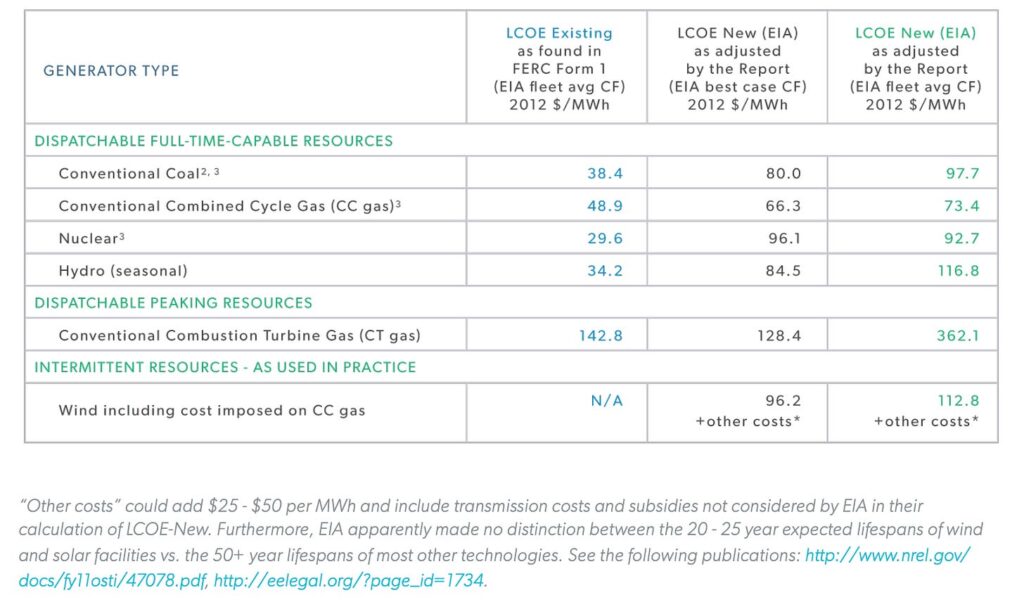
This was an important step because renewable advocates were using the LCOEs of new wind and solar facilities compared with those of new natural gas and coal plants to argue for the closure of existing thermal generators. The IER reports challenged the assumption that replacing existing generation with new generation automatically reduced costs.
IER’s analyses were highly influential in our early work at the Center of the American Experiment, where we showed that retaining existing generators and building new nuclear capacity was more affordable than replacing coal plants with large quantities of new wind, solar, and natural gas.
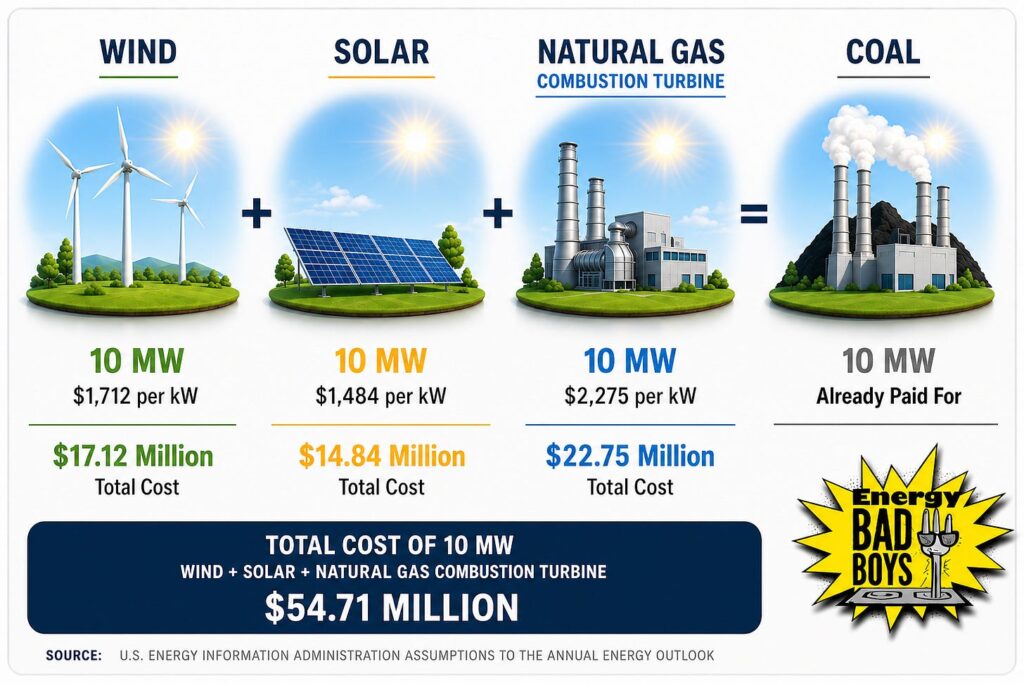
But while this represented an improvement over traditional LCOE comparisons, it still failed to account for many of the hidden system costs associated with intermittent generation.
To address these shortcomings, we published the Renewables Blueprint, highlighting what we called “load balancing costs”—the cost of maintaining reliability while incorporating larger amounts of wind and solar. These costs were reflected in our system modeling, but not yet directly in LCOE estimates.
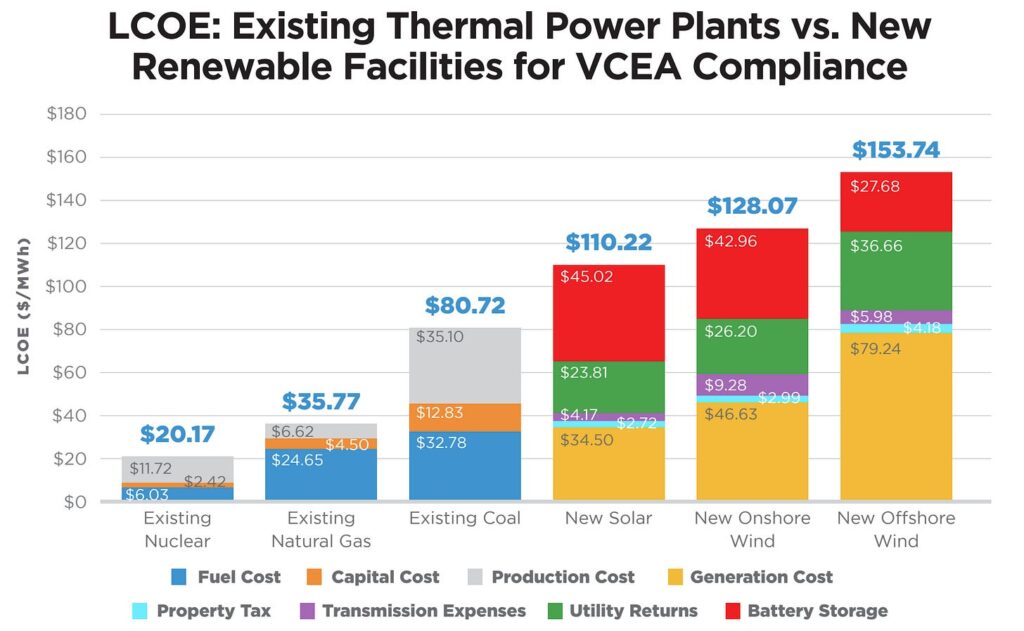
That changed in early 2022. In a report on the Virginia Clean Economy Act, we began incorporating backup energy costs directly into wind and solar LCOEs through battery storage, thanks to Brent Bennett giving us access to our first hourly generation model. We also included transmission costs, utility profits, property taxes, and other costs that traditional LCOE analyses typically ignored.
The results showed much higher costs for wind and solar technologies than traditional LCOE values:
By September 2022, we developed another addition called the “overbuilding and curtailment” cost in our report on Minnesota’s 100 percent carbon-free mandate. This was an incredibly important upgrade, because LCOEs historically levelize the costs of resources over a static capacity factor during the resource’s useful lifespan, even though the effective utilization of wind and solar plummets at higher penetrations due to curtailment.
When we added these hidden costs, the full system costs of wind and solar skyrocketed to $272 and $472, respectively, in our Minnesota report.
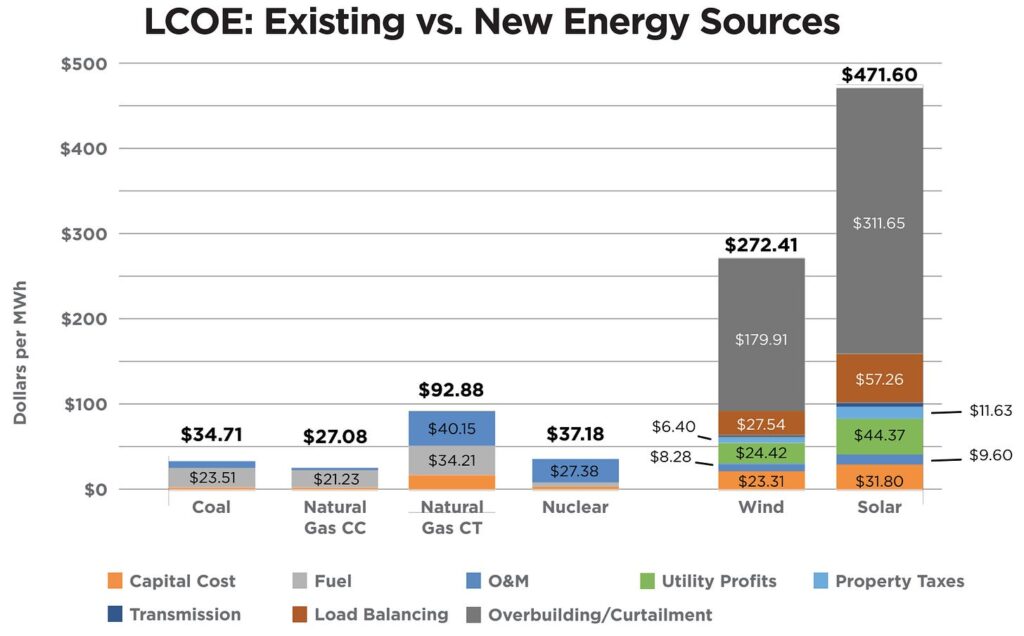
This was the first edition of what we now call the Always On Levelized Cost of Energy (AO-LCOE). For the first time, we were directly incorporating the costs of backup generation, transmission, overbuilding, and curtailment into the cost of wind and solar themselves, rather than pretending those costs existed somewhere else.
To our knowledge, this was among the first practical, policy-facing attempts to quantify the full system costs of wind and solar in a way that could be compared directly with conventional resource options. Other full-system-cost approaches would follow, as discussed below.
LCOE Today
Perhaps the strongest evidence that we are winning the debate over LCOE is that organizations that once relied heavily on traditional LCOE comparisons are increasingly adopting their estimates to address the criticisms they once dismissed.
Historical LCOE reports from organizations like Lazard, which is widely cited by groups using LCOE to advocate for new wind and solar, are now updating their report to include firming costs. Additionally, new metrics have emerged that attempt to account for the full system cost of incorporating intermittent resources onto the grid.
Reformed LCOEs
Lazard
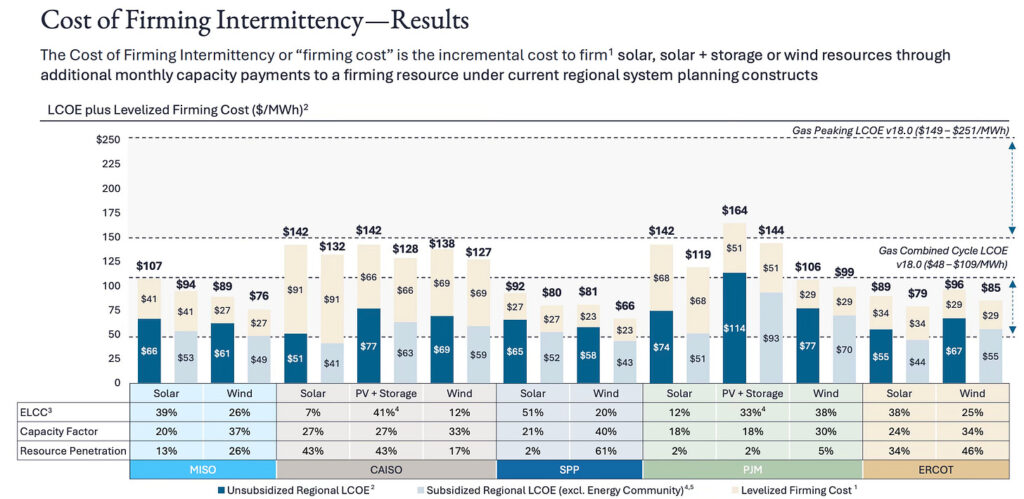
While Lazard still publishes its regular LCOE report without firming costs, it started to incorporate the “Cost of Firming Intermittency” in its 2023 edition. It used ELCC and net-Cost of New Entry (CONE) values to estimate firming costs.
Here is the latest version of the cost of firming numbers in the 2025 report, which we helped Lazard correct after noticing errors in their numbers.
International Renewable Energy Association (IRENA)
Even though IRENA still uses LCOE inaccurately to argue that “Solar and wind have become the cheapest sources of new electricity generation worldwide,” it is now having to contend with the fact that generating “cheap” electricity is not the same as constructing an affordable and reliable electricity system.
It recently published a report, 24/7 Renewables: The Economics of Firm Wind and Solar, where it stated, “Understanding the cost of this ‘firming’ – i.e. transforming variable renewable output into a continuous, dependable supply – is therefore critical for assessing the full economics of renewables in current and future electricity systems.” This is a remarkable admission when compared to the industry’s messaging a decade ago. The debate is no longer about whether these costs exist, but how large they are.
According to IRENA’s assumptions, Firm LCOEs for solar plus storage in the U.S are still above $110 per MWh in 2025.
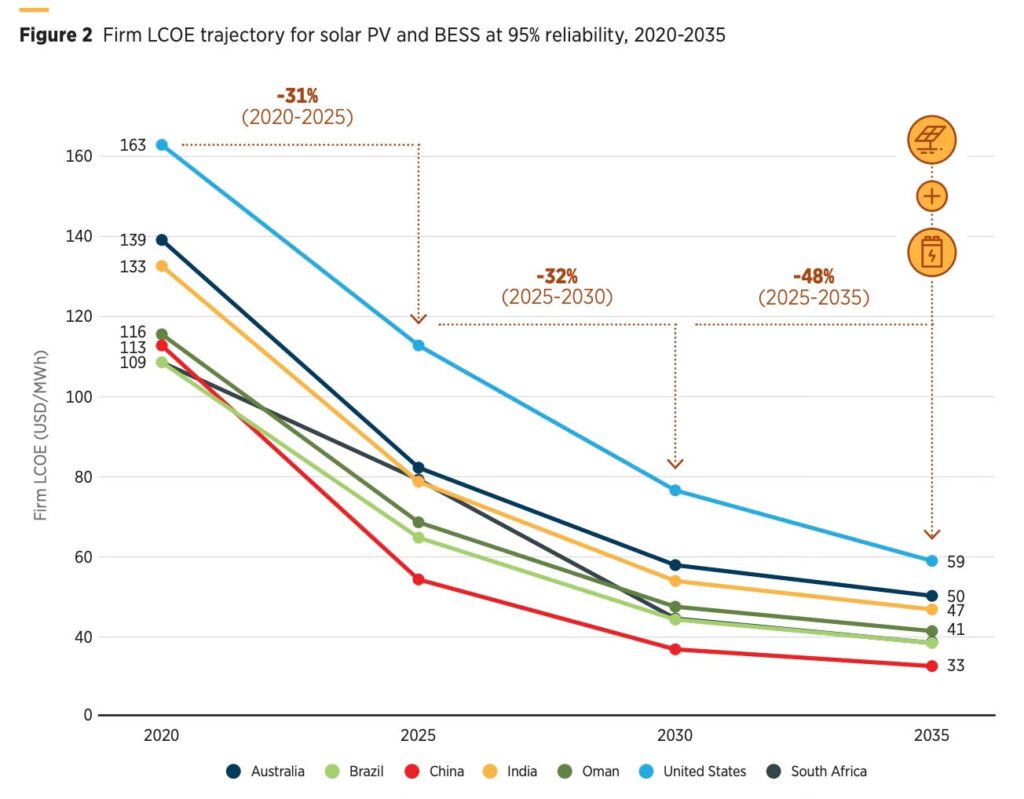
While these numbers are still far too low, and the report essentially revisits the idea of baseload solar (which we have already addressed) while trying to underplay the unreliability of intermittent generation, it’s still a recognition of the lack of “firm” capacity offered by wind and solar.
New Metrics
Always On Levelized Cost of Energy (AO-LCOE)
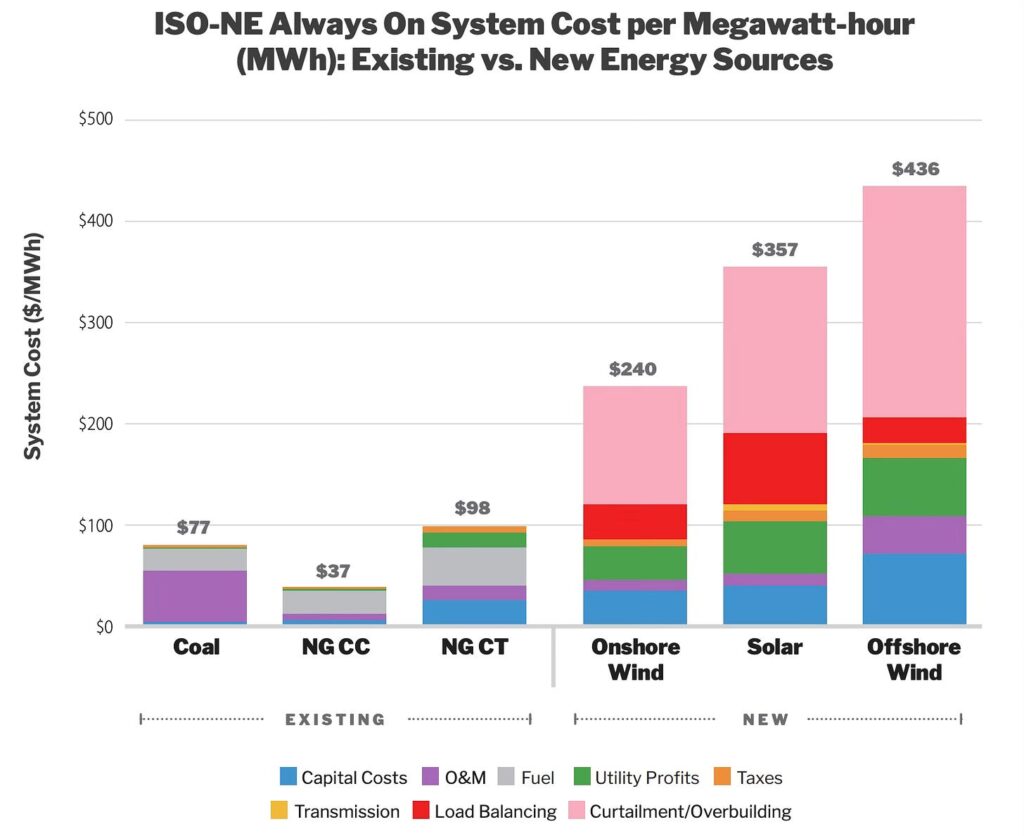
As already mentioned, one of the first practical, policy-facing attempts to quantify the system costs of wind and solar was our very own, which we now call the Always On Levelized Cost of Energy (AO-LCOE). First emerging in 2022, we have used this framework in numerous reports since then, and it incorporates the costs of backup power and of overbuilding and curtailing wind and solar generation at higher penetrations.
The AO-LCOE is system-based, meaning it varies depending on the region being modeled, renewable penetration levels, transmission requirements, and the cost of backup generation. Unlike traditional LCOE, which measures the cost of producing electricity, AO-LCOE measures the cost of delivering reliable electricity every hour of the year.
Here is one of the latest versions in our recent report on ISO-NE.
Leveled Full System Costs of Electricity (LFSCOE)
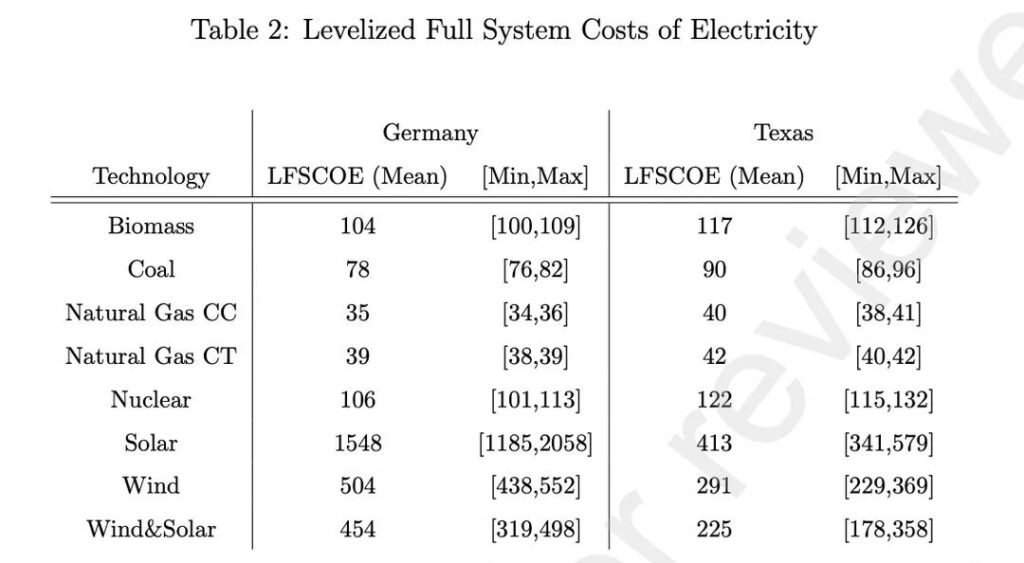
Shortly after we first aired the Always On Levelized Cost of Energy, a report on the Levelized Full System Cost of Electricity (LFSCOE) was published in November of 2022. Author Robert Idel describes it as a “cost evaluation metric that compares the costs of serving the entire market using just one source plus storage.”
In theory and practice, it is fairly similar to the AO-LCOE. It attributes the cost of firming and balancing wind and solar on different electricity grids directly to the cost of wind and solar.
In the table below, note that the Texas values for wind ($291/MWh) and solar ($413/MWh) are fairly similar to our results for Minnesota just a few months before (wind at $272/MWh and solar at $472/MWh). While wind is very close, the differences in solar likely result from better solar resources in Texas.
Conclusion
The debate is not over, but it is clearly moving in our preferred direction.
Fifteen years ago, advocates routinely used LCOE to argue that wind and solar were, or would soon be, the cheapest sources of electricity. Today, many of those same organizations are publishing firming-cost analyses, exploring full-system-cost frameworks, and acknowledging that generating electricity is not the same thing as building an affordable and reliable electricity system.
This is an admission that the critics of the idea that wind and solar were the cheapest forms of energy were right. Wind and solar were never the most affordable—the hidden costs were simply being ignored by the metrics used to sell the idea.
The debate over LCOE has always centered on whether the metric should be treated as a comprehensive measure of the cost of serving electricity demand. It should not be. LCOE can measure the cost of generating electricity, but it cannot measure the full cost of building and operating a reliable electricity system.
Lazard now publishes firming costs. IRENA is studying the economics of firm renewable generation. The United Nations Economic Commission for Europe (UNECE) has launched an initiative to develop full-system-cost methodologies. Organizations that continue to advocate for large-scale renewable deployment increasingly acknowledge that reliability, backup generation, storage, transmission, overbuilding, and curtailment must be accounted for.
The question is no longer whether these costs exist, but how large they are and how they should be measured. That alone represents a remarkable change from where the industry stood just a decade ago.
This piece was originally published by Isaac Orr and Mitch Rolling at Energy Bad Boys on Substack on June 20, 2026.