Renewable portfolio standards already force electricity suppliers to buy renewable energy certificates. Several states add insult to injury by requiring a share of certificates come from generators inside their own borders, even when identical renewable energy certificates are available elsewhere for a fraction of the price.
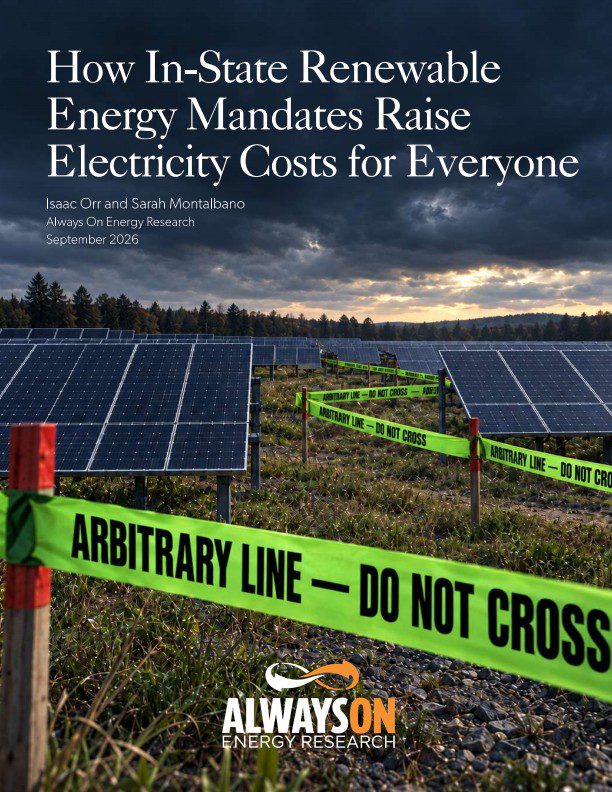
Always On Energy Research’s new report on behalf of the DCI Group, How In-State Renewable Energy Mandates Raise Electricity Costs for Everyone, quantifies what those border-closing rules cost ratepayers in Maryland, Massachusetts, New Jersey, Pennsylvania, and Washington, D.C.
- Local solar or other geographically restricted credits accounted for 51 percent of New Jersey’s RPS costs, 52 percent of Pennsylvania’s costs, and approximately 57 percent of Washington, D.C.’s costs in the latest reporting years.
- Consumers pay enormous premiums for locally mandated credits. D.C. solar credits cost more than 16 times as much as its ordinary renewable credits and 177 times as much as Texas solar credits. New Jersey solar credits cost approximately six and a half times as much as the broader regional credits available elsewhere in PJM.
- These mandates now impose substantial costs on families and businesses. Based on independent modeling, RPS requirements added approximately $298 per electricity customer in New Jersey, $227 in Maryland, $125 in Pennsylvania, and nearly $775 per customer in Washington, D.C., in the latest years analyzed. Massachusetts RPS and clean-energy mandates cost customers approximately $18 per month on average from 2007 through 2025.
- These mandates are increasingly liable to federal dormant Commerce Clause challenges. West Virginia’s September 2026 lawsuit against Pennsylvania in federal court — alleging its in-state requirements for solar and Tier II credits unlawfully discriminate against out-of-state generators — could be the first of many lawsuits as protectionist RPS costs climb and electricity prices become a potent political liability.
- Allowing greater competition would produce immediate savings. Purchasing less-expensive credits from outside state borders could have saved approximately $553 million in New Jersey,
$154 million in Washington, D.C., and $100 million in Maryland in a single year. Reopening Pennsylvania’s Tier II market could save another $270 million annually.
The report recommends repealing RPS mandates or, at a minimum, eliminating in-state requirements and solar carve-outs that unnecessarily inflate costs.
Read the full report, How In-State Renewable Energy Mandates Raise Electricity Costs for Everyone, at this link. Direct media inquiries to [email protected].